
Grounding Interventions: An Ethnographic Analysis of Government and Non-Governmental Food Security Efforts in Rural Tigray, Ethiopia
Hagos Gebremariam1
*
 , D. James Narendra Bondla2
and Tesfaalem Gebreyohannes3
, D. James Narendra Bondla2
and Tesfaalem Gebreyohannes3
1
Department of Sociology,
Adigrat University,
Adigrat,
Ethiopia
2
Frobenius Institute for Research in Cultural Anthropology,
Goethe University,
Frankfurt am Main,
Germany
3
Department of Geography and Environmental Studies,
Mekelle University,
Ethiopia
http://dx.doi.org/10.12944/CWE.20.3.17
Copy the following to cite this article:
Gebremariam H, Bondla J. N, Gebreyohannes T. Grounding Interventions: An Ethnographic Analysis of Government and Non-Governmental Food Security Efforts in Rural Tigray, Ethiopia. Curr World Environ 2025;20(3). DOI:http://dx.doi.org/10.12944/CWE.20.3.17
Copy the following to cite this URL:
Gebremariam H, Bondla J. N, Gebreyohannes T. Grounding Interventions: An Ethnographic Analysis of Government and Non-Governmental Food Security Efforts in Rural Tigray, Ethiopia. Curr World Environ 2025;20(3).
Download article (pdf)
Citation Manager
Publish History

Introduction
Food insecurity is still one of the most severe and enduring socioeconomic problems in the world, especially in the Horn of Africa, where political unrest and climatic shocks constantly increase vulnerability.1 Since the mid-2000s, government policies, such as the extensive Productive Safety Net Programme (PSNP), and various non-governmental humanitarian initiatives have attempted to address the widespread problem of chronic and acute hunger in Ethiopia, and more especially in the Tigray National Regional State.2,3 According to empirical research, these interventions such as water harvesting projects and public works initiatives have improved household calorie consumption and protected assets in certain places.3,4 The general situation of food security is still unstable, nevertheless, since recent environmental stresses and conflicts have drastically reversed progress and forced a sizable percentage of the rural population into extreme food insecurity.5,6
While there are many quantitative impact evaluations that concentrate on the efficacy of interventions (such as food assistance and PSNP), the research often stays far away from the complex, day-to-day discussions that influence families' paths toward food security.7,8 Although essential, economic and technical assessments usually ignore the subjective aspect of food security the power relationships, social processes, and regional cultural norms that influence access to and use of resources and assistance.9 A significant theoretical vacuum concerning the practical foundation of formal interventions is created by this omission: how do policies of the government and non-governmental organizations translate into lived realities? The study uses a qualitative ethnographic analysis to go beyond aggregate statistics in order to address this. This study aims to understand the situated politics of food aid, the cultural justifications for household coping mechanisms, and the ensuing unintended consequences of intervention design on local livelihoods by investigating the micro-level implementation of food security initiatives throughout rural Tigray. Furthermore, its findings offer crucial lessons for the design of resilience-focused and culturally sensitive food security programs in other conflict-prone and climatically vulnerable regions across the Horn of Africa and beyond.
Materials and Methods
Research Methodology
Study Area
The study was carried out in the tabias of Agazi, Beleso, and Guahgot in rural Tigray, Ethiopia. These sites were intentionally chosen to exemplify regions facing diverse levels of food insecurity, environmental strain, and the involvement of both governmental and non-governmental solutions.
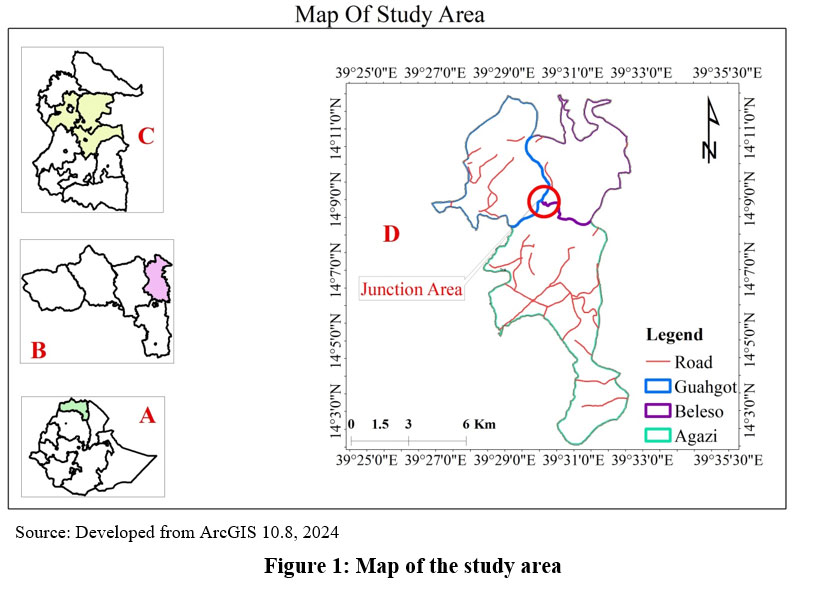 | Figure 1: Map of the study area
|
Research Design
A mixed-methods approach was utilized to elucidate the complex interactions among food security, governmental and NGO interventions, and community adaptation. This approach combined quantitative surveys with qualitative ethnographic methodologies, which made it possible to fully grasp how households lived, how institutions worked, and how communities were able to bounce back from problems.
Data Collection
Quantitative Data: 342 rural families were surveyed using stratified random sampling to make sure that all socio-economic groups were represented. The stratification parameters used were: a) Tabia (Agazi, Beleso, Guhagot), b) Livelihood Type (Farming vs. Non-Farming), and c) Gender of Household Head (Male vs. Female) to ensure proportional representation of vulnerable and key demographics.
Survey data were focused on people's demographics, their livelihoods, their food security, their engagement in government and NGO initiatives, and the ways they adjust to changes in their lives.
Qualitative Data: In-depth interviews were carried out with community leaders, key informants, and representatives of local institutions to examine perceptions of intervention efficacy, obstacles, and local adaptation techniques. A total of 30 semi-structured interviews were conducted, including 15 with community leaders and 15 with institutional key informants (e.g., local PSNP coordinators, NGO field staff). Interviews lasted approximately 60–90 minutes. Participant selection was purposive, focusing on individuals with a direct role in program implementation or extensive community knowledge.
Focus Group Discussions (FGDs) involved rural households to corroborate survey results, examine shared experiences, and uncover indigenous knowledge and social networks pertinent to food security. Six FGDs were held (two per tabia, with 8–10 participants each). Topics included barriers to long-term resilience, perceived program ownership, and the role of traditional coping mechanisms.
Data Analysis
Quantitative data were examined using descriptive statistics, frequencies, and cross-tabulations to determine trends in food security, program participation, and coping mechanisms. All quantitative analysis was performed using SPSS (Version 26). Statistical tests, including Chi-Square tests, were employed to assess for significant associations between food security status and variables like Tabia or livelihood type. Qualitative data from interviews and FGDs were submitted to thematic analysis to discover patterns related to intervention effectiveness, indigenous practices, and household resilience. The qualitative analysis followed a six-phase thematic analysis approach.10 Data was transcribed and coded using NVivo 12 software. An iterative process was used to develop emergent themes, with initial codes derived from the interview guides and subsequent codes based on participant responses. Inter-coder reliability was confirmed by a second researcher coding a subset of the transcripts (10%) to ensure consistency in theme development and rigor. Findings from both datasets were merged to provide a complete view of food security dynamics and the interplay between institutional interventions and local adaptive capacities.
Ethical Considerations
All participants provided informed consent, and confidentiality was strictly maintained. Ethical clearance for this study was granted by the Institute of Paleo-environment and Heritage Conservation (IPHC), Department of Anthropology, Mekelle University (Reference No. DA/35/23/-24/02/2025), and the research adhered to the university's ethical guidelines for research involving human subjects. Ethical engagement with the community ensured that interpretations reflected local realities and were culturally sensitive.
Justification
The mixed-methods ethnographic approach allows for an in-depth analysis of how households overcome food insecurity while interacting with government and NGO interventions. Specifically, the quantitative data provides statistically representative evidence on the prevalence of food insecurity and program participation, while the qualitative, ethnographic data fills a critical gap by providing the 'lived realities' and 'situated politics' often missing in technical assessments of food security interventions.7,8 This methodology is particularly suitable for analyzing both the short-term outcomes and long-term resilience benefits of food security programs in complex socio-environmental environments like rural Tigray.
Result and Discussion
Table 1: Demographic Characteristics of Respondents
Variable | Category | Frequency | Percent (%) |
Gender | Male | 198 | 57.9 |
Female | 144 | 42.1 | |
Age group (years) | 18–30 | 79 | 23.1 |
31–45 | 120 | 35.1 | |
46–60 | 94 | 27.5 | |
61+ | 49 | 14.3 | |
Education level | No formal edu. | 122 | 35.7 |
Primary | 140 | 40.9 | |
Secondary+ | 80 | 23.4 | |
Main livelihood | Farming | 288 | 84.2 |
Non-farming | 54 | 15.8 |
The demographic profile of respondents (N = 342) provides important background information for understanding livelihood strategies, adaptive skills, and household resilience, as seen in the above table. There is a little male majority in the sample, with 57.9% of respondents being men and 42.1% being women. This gender distribution is important as it may affect labor allocation, family decision-making, and resource availability, since rural male and female roles often vary in agricultural civilizations.11
The age distribution shows that the majority of respondents (35.1%) are between the ages of 31 and 45, followed by those between the ages of 46 and 60 (27.5%), 18 and 30 (23.1%), and the smallest group, those 61 and over (14.3%). The population actively working, competent to handle agricultural duties, and able to transfer information and skills among homes is reflected in this middle-aged skew. Older respondents provide experience and traditional knowledge, which are both essential to family and community resilience, while younger individuals represent prospective labor and innovation ability.12
According to educational attainment, the majority of respondents had little formal education 35.7% have never attended school, 40.9% have finished elementary school, and just 23.4% have completed secondary school or beyond. This implies that a sizable fraction of households might have trouble obtaining agricultural extension services, technical knowledge, and other sources of income, all of which can impair their ability to adapt to shocks from the environment and the socioeconomic sector.13
In terms of livelihood, the results demonstrate the study population's agricultural character: 84.2% of respondents work mainly in agriculture, while just 15.8% participate in non-farming occupations. In addition to highlighting the significance of interventions that improve sustainable farming practices, diversification, and access to agricultural support services, the heavy reliance on agriculture highlights vulnerability to market fluctuations, land degradation, and climate variability.14
Table 2:. Perceived Food Security Status of Households (2024)
Tabia | Food Secure (%) | Moderately Insecure (%) | Severely Insecure (%) |
Agazi | 24.3 | 33.1 | 42.6 |
Beleso | 29.4 | 37.7 | 32.9 |
Guhagot | 44.7 | 35.2 | 20.1 |
Significant differences in the three research locations' perceptions of food security are shown by the results in Table 2. In Agazi, just 24.3% of families consider themselves to be food secure, while the biggest percentage (42.6%) describe being seriously food insecure. This shows that over half of the population has severe food access issues, underscoring their extreme susceptibility to economic and environmental shocks. Qualitative data from FGDs in Agazi corroborated this, with many participants describing a reliance on emergency food aid after the armed conflict, rather than own production. A much less dire image is painted by Beleso, where 29.4% of families identify as food secure, 32.9% as extremely insecure, and 37.7% as moderately insecure. These findings imply that despite the pervasiveness of food insecurity, a sizable percentage of families are able to meet their subsistence requirements, perhaps by using coping mechanisms including social networks, labor exchange, and diversification.
On the other hand, Guhagot's food security profile is comparatively superior. Key informant interviews in Guhagot highlighted the greater success of their small-scale irrigation projects, which had been supported by a longer-term NGO partner and resulted in more diversified crop production. Of these families, just 20.1% claim severe food insecurity, compared to 44.7% who report food security. Guhagot's larger percentage of families experiencing food insecurity might be explained by more diverse livelihoods, more fertile land, or more robust community-based support networks. According to the statistics, food insecurity is still a major problem overall, especially in Agazi and Beleso. A Chi-Square test for independence indicated a statistically significant association between Tabia and perceived food security status (x2(4,N=342)=21.8,p<.001), supporting the regional differences observed. This is because to larger structural vulnerabilities such land degradation, a lack of income, and climatic variability.15,16
These results focus the critical need for focused interventions that strengthen adaptive ability at the family level as well as more extensive systemic assistance, such as enhanced social protection systems, diversification of livelihoods, and sustainable agriculture practices. These kinds of actions are essential for lowering food security gaps across various groups and enhancing resistance to frequent shocks.
Table 3: Effectiveness of Government Interventions (PSNP and Related Programs)
Indicator | Agazi (%) | Beleso (%) | Guhagot (%) | Overall (%) |
Improved short-term food access | 68.1 | 71.5 | 73.2 | 70.9 |
Enhanced resilience (long-term) | 32.6 | 37.4 | 46.8 | 38.9 |
Participation in PSNP works | 59.3 | 61.8 | 65.4 | 62.2 |
Perceived community ownership | 27.4 | 29.6 | 35.7 | 30.9 |
The information in Table 3 shows how well government programs especially the Productive Safety Net Program (PSNP) and associated projects are thought to have improved family food security and resilience. According to 70.9% of respondents overall, most respondents in all study regions acknowledge that these initiatives have increased short-term food availability. According to,17 this illustrates the program's immediate effect in resolving acute food shortages, guaranteeing that families can fulfill basic nutritional requirements during challenging times, and serving as a vital buffer against food insecurity.
The perceived efficacy of these therapies, however, seems to be much lower when assessing long-term resilience. The percentage of respondents who think PSNP has much improved their capacity to endure shocks in the future is only 38.9%. This implies that while the program reduces hunger in the short term, it may not be as effective in enhancing long-term adaptive ability, such as increasing agricultural output, diversifying sources of income, or boosting revenue-generating possibilities.2
With 62.2% of families participating in program activities, PSNP participation is comparatively high, suggesting a respectable degree of community engagement. However, at just 30.9%, perceived community ownership is noticeably low, suggesting a possible lack of local involvement and decision-making. Because families may not fully incorporate program benefits into larger livelihood strategies or community-driven adaptation activities, low ownership may restrict the efficacy of interventions in creating long-term resilience.18
Table 4. NGO Interventions in Food Security
Indicator | Agazi (%) | Beleso (%) | Guhagot (%) | Overall (%) |
Capacity building (training, awareness) | 45.6 | 48.9 | 57.1 | 50.5 |
Infrastructure support (water, roads) | 28.3 | 31.2 | 36.8 | 32.1 |
Resilience-focused interventions | 34.5 | 37.7 | 49.6 | 40.6 |
Community participation in design | 23.1 | 25.8 | 29.3 | 26.1 |
The results shown in Table 4 demonstrate the contribution and perceived efficacy of NGO interventions in improving household resilience and food security across the research regions. The majority of respondents (50.5%) agreed that NGOs had helped by implementing capacity-building initiatives including awareness and training campaigns. In order to increase long-term resilience and help communities deal with food insecurity, it is imperative that NGOs significantly contribute to the improvement of household knowledge, skills, and adaptive methods.
However, just 32.1% of respondents acknowledged improvements, indicating that NGOs' influence on the development of infrastructure such as roads, water supplies, and market access is seen to be rather limited. Lack of infrastructure might limit access to basic services, market linkages, and agricultural output, indicating a sector where NGO initiatives may need to be expanded for more significant and long-lasting results.
40.6% of respondents recognize resilience-focused programs, including small-scale irrigation, climate-adaptive activities, and assistance for varied livelihoods. This suggests that while NGOs can build adaptive capacity, their efficacy and reach in fostering systemic resilience vary depending on the research location. Guhagot's somewhat higher recognition rate (49.6%) might be attributed to regional achievements in integrating these programs with pre-existing environmental factors or community structures.
Last but not least, the lowest percentage of community involvement in program design 26.1% indicates that NGO initiatives may often be pushed by outside forces with little consideration for local goals and expertise. Because interventions that don't fit with community needs and cultural norms are less likely to be sustained or expanded, low levels of participatory involvement may lower program relevance, ownership, and sustainability.19
Table 5: Key Challenges to Food Security Interventions (Household Perspective)
Challenge Category | % of Respondents Identifying |
Climate change variability | 67.8 |
Poor infrastructure (roads, irrigation) | 59.3 |
Policy inconsistency & weak implementation | 52.6 |
Resource scarcity (financial & material) | 49.4 |
Limited coordination between actors | 44.7 |
Low community ownership | 41.5 |
The main obstacles to food security interventions as seen by families are shown in Table 5, which reflects institutional and environmental limitations. The difficulty that respondents mention the most is climate change variability, which was mentioned by 67.8% of them. Climate-adaptive techniques are necessary in intervention programs because of the widespread effects of droughts, altered rainfall patterns, and other climate-induced shocks on family food security and agricultural.15,16
Logistical constraints limit access to markets, water, and agricultural inputs, which lowers the efficiency of food security measures. This is evident from the fact that 59.3% of respondents cited poor infrastructure, including insufficient roads and irrigation systems. Even well-designed interventions may fail if governance structures and regulatory frameworks are not consistently enforced or tailored to local settings, as shown by 52.6% of households citing policy inconsistency and insufficient implementation as additional program effect constraints.14
49.4% of respondents said they were impacted by resource scarcity, which includes both material and financial limitations. This indicates that a lack of program funds, inputs, or technology may limit the reach and durability of interventions. Major socio-institutional constraints include inadequate community ownership (41.5%) and poor coordination between actors (44.7%). Programs' relevance, acceptability, and long-term sustainability are diminished by implementing agencies' fragmentation and low levels of participation, underscoring the need of integrated, community-centered methods.19
Table 6: Opportunities for Strengthening Interventions
Opportunity Area | % of Respondents Supporting |
Leveraging indigenous knowledge | 61.7 |
Women-led food networks | 54.2 |
Climate-resilient agriculture | 47.5 |
NGO–Government collaboration | 46.8 |
Participatory planning approaches | 44.1 |
According to households, the results in Table 6 highlight a number of important chances to improve the sustainability and efficacy of food security initiatives. In order to create resilience, the majority of respondents (61.7%) stressed the need of using indigenous knowledge and the importance of customary practices including rotating savings (iqub), mutual help (idir), and labor exchange (lifinti). Through integrating these culturally embedded systems into official initiatives, adaptive capabilities based on community experience may be strengthened and local ownership, sustainability, and relevance can be increased.20, 21
According to 54.2% of respondents, women-led food networks provide a significant potential. In social cohesion, food production, and distribution, women often play key roles. By fostering female leadership in communal networks, we may increase resilience at the home and community levels. Empowering women in these jobs has been shown to promote societal cohesiveness, creativity in coping mechanisms, and food security outcomes.22
Supported by 47.5% of respondents, climate-resilient agriculture offers a chance to lessen susceptibility to environmental shocks. Techniques including soil conservation, varied cropping systems, and drought-tolerant crops may help families better adjust to recurring dangers and increase production in the face of climate change.16
Combining resources, technical know-how, and program reach may increase the effect of coordinated actions, according to the potential for NGO–government partnership (46.8%). Reduction of duplication, enhancement of service delivery, and guarantee of contextually suitable and durable interventions are all possible via successful collaborations between NGOs and governmental entities.
Lastly, 44.1% of respondents said that using participatory planning techniques may improve the efficacy of the intervention. Long-term results are improved when communities are involved in program planning and decision-making because it guarantees alignment with local needs, promotes ownership, and increases the adoption of solutions.19
Recommendations
Enhance Government–NGO Coordination: Establish institutional structures for cooperation between governmental agencies and NGOs to align goals, maximize resource usage, and assure continuation of resilience-focused programs.
Integrate Long-Term Resilience into Programs: Food security initiatives should transcend beyond immediate aid and embrace measures such as climate-smart agriculture, sustainable land management, and infrastructure upgrades to develop household and community resilience.
Encourage Local Ownership and Participation: Encourage participatory planning procedures that include communities in program design, monitoring, and decision-making to make that interventions are locally owned, culturally relevant, and context-specific.
Make Use of Indigenous Knowledge and Social Networks: To improve the efficacy and durability of treatments, acknowledge and include traditional coping mechanisms such as mutual assistance systems, women-led networks, and labor exchange.
Deal with Environmental and Structural Issues: To lessen risks and increase the effectiveness of food security programs, invest in climate adaptation strategies, upgrade rural infrastructure, and coordinate the application of policies.
Conclusion
According to the research, government interventions, notably the Productive Safety Net Program (PSNP), have been helpful in boosting short-term food supply, but they haven't done much to create long-term family resilience. Through resilience-focused programs and capacity-building initiatives, NGOs have made a considerable contribution; yet, their usefulness is restricted by a lack of finance, insufficient coordination, and a lack of local engagement. Rural households face multiple challenges including climate variability, weak infrastructure, policy inconsistencies, and low community ownership that exacerbate food insecurity and limit the sustainability of interventions. At the same time, opportunities exist in the form of indigenous knowledge systems, women-led food networks, climate-smart agricultural practices, and participatory planning, all of which offer pathways to strengthen resilience and adaptive capacity. The findings underscore the necessity of integrating local knowledge, gender-sensitive strategies, and coordinated multi-stakeholder interventions into food security programs.
Acknowledgement
This research, titled Grounding interventions: An ethnographic analysis of government and non-governmental food security efforts in rural Tigray, Ethiopia, would not have been possible without the generous support and invaluable guidance of several individuals and institutions. We express sincere appreciation to the faculty and staff of the Department of Anthropology (IPHC), Mekelle University and Department of Sociology, Adigrat University, for providing an intellectually stimulating environment and essential institutional support for the study research. Most importantly, we remain profoundly indebted to the resilient community members, farmers, female household heads, village elders, and local administrators across the study area that generously shared their time, lived experiences of food insecurity, erosive coping strategies, and shock exposure. Their candid narratives from focus group discussions and key informant interviews form the ethnographic
foundation grounding this quantitative analysis of household vulnerabilities. Their trust and participation amidst ongoing post-conflict recovery challenges made this work possible.
Funding Sources
The author(s) received no financial support for the research, authorship, and/or publication of this article.
Conflict of Interest
The authors do not have any conflict of interest.
Data Availability Statement
All materials and data supporting the findings of this study are available from the corresponding author upon reasonable request.
Ethics Statement
This study received ethical approval from the Institutional Research Ethics Review Committee (IRERC) of Adigrat University. The research protocol was reviewed and granted expedited approval (Reference No. IRERC 0004/2024) on 06 December 2024, with approval valid through 05 December 2025.The study was conducted in accordance with national and international ethical guidelines.
Informed Consent Statement
Informed consent procedures were reviewed and approved by the Institutional Research Ethics Review Committee of Adigrat University. Informed consent was obtained from all participants involved in the study in accordance with the approved protocol.
Permission to Reproduce Material from Other Sources
All materials used in this study are original. No copyrighted material from other sources was reproduced, and therefore no additional permissions were required.
Author Contributions
Hagos Gebremariam: Responsible for Conceptualization and Methodology. Led the Data Collection and Analysis, and prepared the Writing Original Draft. Contributed significantly to Writing Review & Editing.
D. James Narendra Bondla: Provided Advising, Supervision and Review & Editing.
Tesfaalem Gebreyohannes: Provided Advising and Supervision.
References
- FAO, IFAD, UNICEF, WFP, & WHO. The State of Food Security and Nutrition in the World 2020: Transforming food systems for affordable healthy diets. Rome: FAO;2020
- Gilligan, D. O., Hoddinott, J., & Taffesse, A. S. The impact of Ethiopia’s Productive Safety Net Programme on household food security. International Food Policy Research Institute (IFPRI) Discussion Paper 00953. 2010 https://www.ifpri.org/publication/impact-ethiopias-psnp-household-food-security.
- Hailu, A. G., & Amare, Z. Y. Impact of productive safety net program on food security of beneficiary households in western Ethiopia: A matching estimator approach. PLoS ONE.2022;17(1), e0260817.
CrossRef - Taffesse, A. S., Tadesse, F., & Guta, F. The impact of Ethiopia’s Productive Safety Net Programme: An update on key outcome indicators. IFPRI Discussion Paper, (1255). International Food Policy Research Institute; 2013.
- Gebrihet, S. G., Tesfay, H. T., & Weldegiargis, M. Y. Armed conflict and household food insecurity: impacts and coping strategies in the conflict-affected rural settings of Tigray, Ethiopia. Cogent Social Sciences.2025;11(1). (Article ID is derived from the search snippet for recent conflict-related data).
CrossRef - Weldegiargis, M. Y., Tesfay, H. T., & Gebrihet, S. G. Drivers of rural–urban food insecurity disparities in war-affected settings of Tigray, Ethiopia: a decomposition approach to policy and intervention insights. International Journal of Social Safety Science and Practice.2023; (Article ID is derived from the search snippet for recent conflict-related data).
- Enten, F. Food Aid Targeting in Ethiopia: An Ethnographic Study of the Early Warning System in the North-Western Zones of the Amhara Regional State. In E. Ficquet, A. H. Omer, & T. Osmond (Eds.), Movements in Ethiopia, Ethiopia in Movement (Volume 2). Centre français des études éthiopiennes.2016
CrossRef - Hagberg, S., & Widmark, C. (Eds.) Ethnographic Practice and Public Aid: Anthropologists Encountering Development. Berghahn Books. 2014
- Weldemariam, L. F., Sakdapolrak, P., & Ayanlade, A. Household food-security strategies and migration in Tigray, Northern Ethiopia. Migration and Development.2023;12(3).
CrossRef - Braun, V., & Clarke, V. Using thematic analysis in psychology. Qualitative Research in Psychology. 2006;3(2):77–101. https://doi.org/10.1191/1478088706qp063oa
CrossRef - FAO. The state of food and agriculture 2021: Making agrifood systems more resilient to shocks and stresses. Food and Agriculture Organization of the United Nations. https://doi.org/10.4060/cb4476en
CrossRef - ILO. World employment and social outlook: Trends 2020. International Labour Organization;2020. https://www.ilo.org/global/research/global-reports/weso/2020/lang--en/index.htm
- UNESCO. Education for sustainable development: A roadmap. United Nations Educational, Scientific and Cultural Organization;2022. https://unesdoc.unesco.org/ark:/48223/pf0000374896
- World Bank. World development report 2023: Migrants, refugees, and societies. The World Bank;2023. https://doi.org/10.1596/978-1-4648-1941-5
- Gebreselassie, S., Fekadu, M., & Taddese, T. Soil degradation, crop productivity, and livelihood vulnerability in Northern Ethiopia. Environmental Development.2021;40, 100655. https://doi.org/10.1016/j.envdev.2021.100655
CrossRef - Tilahun, B., & Taye, A. Land degradation and adaptation strategies among smallholder farmers in Tigray, Ethiopia. Land Degradation & Development.2020; 31(17):2380–2391. https://doi.org/10.1002/ldr.3574
CrossRef - Berhane, G., Hoddinott, J., Kumar, N., & Taffesse, A. S. The impact of Ethiopia’s Productive Safety Net Programme and its linkages. Journal of Development Studies.2014; 50(10):1372–1392. https://doi.org/10.1080/00220388.2014.931835
CrossRef - Hoddinott, J., Berhane, G., Gilligan, D., & Kumar, N. Household participation in Ethiopia’s Productive Safety Net Program. Food Policy.2012;37(2):182–193. https://doi.org/10.1016/j.foodpol.2011.12.004
- Taye, H., & Gebremedhin, B. Enhancing participatory approaches in NGO-led food security programs: Evidence from Tigray, Ethiopia. Journal of Rural Studies.2021;85:202–214. https://doi.org/10.1016/j.jrurstud.2021.06.004
CrossRef - Djoudi, H., & Brockhaus, M. The role of gender in vulnerability, adaptation, and resilience. In N. L. Shackleton et al. (Eds.), Climate change adaptation in Africa: Fostering resilience and capacity in African communities. 2019; pp. 67–83. Routledge.
- Devereux, S., & Taye, H. Social protection in Africa: Emerging trends and challenges. Development Policy Review.2021;39(3):360–378. https://doi.org/10.1111/dpr.12487
CrossRef - Kassie, M., Ndiritu, S. W., & Stage, J. Women’s participation in agricultural cooperatives and household food security: Evidence from rural Ethiopia. Agricultural Economics.2020;51(2):211–225. https://doi.org/10.1111/agec.12549
CrossRef