
Quantification and Utilization Potential for Energy Recovery and Environmental Implications of Apple Pruned Residue
Vipasha Sharma1
 , Rajeev Kumar Aggarwal1
*
, Pratima Vaidya1
, Hukam Chand Sharma1
and Ghanshyam Agrawal2
, Rajeev Kumar Aggarwal1
*
, Pratima Vaidya1
, Hukam Chand Sharma1
and Ghanshyam Agrawal2
1
Department of Environmental Science,
Dr. YS Parmar University of Horticulture and Forestry,
Solan,
Himachal Pradesh
India
2
Department of Soil and Water Management,
Dr. YS Parmar University of Horticulture and Forestry,
Solan,
Himachal Pradesh
India
http://dx.doi.org/10.12944/CWE.20.2.11
Copy the following to cite this article:
Sharma V, Aggarwal R. K, Vaidya P, Sharma H. C, Agrawal G. Quantification and Utilization Potential for Energy Recovery and Environmental Implications of Apple Pruned Residue. Curr World Environ 2025;20(2). DOI:http://dx.doi.org/10.12944/CWE.20.2.11
Copy the following to cite this URL:
Sharma V, Aggarwal R. K, Vaidya P, Sharma H. C, Agrawal G. Quantification and Utilization Potential for Energy Recovery and Environmental Implications of Apple Pruned Residue. Curr World Environ 2025;20(2).
Download article (pdf)
Citation Manager
Publish History

Introduction
Pruning is considered a vital methodology involving the selective excision of undesired components from apple plants, resulting in the generation of substantial quantities of woody waste debris. The handling of this substantial quantity of pruned waste presents a significant challenge for farmers. Due to its considerable volume and the lack of standardized management procedures, it is often incinerated in open fields, resulting in pronounced air pollution in apple-producing areas. The incomplete combustion of biomass-derived fuels may yield byproducts such as particulate matter, carbon monoxide, nitrogen dioxide, and polycyclic aromatic hydrocarbons.1 These burning activities release substantial carbon emissions, which not only negatively impact the global climate system but also pose significant health risks to local populations.2 Nevertheless, existing alternatives to this methodology, including the chipping of wood for use as mulch, present their own set of disadvantages.3,4 Utilizing this waste as biofuel offers significant potential to alleviate the strain on natural resources and mitigate the antecedents of air pollution and global warming.5 Therefore, the proper management and disposal of pruning tree waste should include consideration of its ecological value and potential for industrial reuse to generate sustainable products.6
The pruned residues and the wood extracted from trees in the management of apple orchards in Italy were quantified, revealing that the average pruned weight on a dry basis is 1.15 t/ha, accompanied by an average moisture content of 56.7%. The management of pruned apple wood represents an effective strategy for addressing climate change mitigation.7 Appropriate management practices have the potential to mitigate carbon emissions by promoting enhanced carbon sequestration, optimizing energy efficiency, and improving overall soil health through the application of amendments. The implementation of sustainable waste management practices has the potential to reduce greenhouse gas emissions linked to the cultivation of apples. The transformation of pruned biomass into usable heat appears to present an economically viable alternative for orchard proprietors.8 Thus far, the biomass generated in fruit plantations has not been utilized for bio-energy production, primarily due to insufficient scientific data regarding the quantity, quality, and energy potential of pruned residues.
Therefore, quantifying trimmed waste and its energy potential is crucial for its environmentally sustainable and economically viable use. To assess the energy potential of biomass, especially horticultural trimmed residue, it is essential to examine both combustible and non-combustible materials. The primary combustible element is carbon; therefore, an increase in carbon concentrations within biomass correlates with an elevated heating value.
The presence of elevated moisture levels diminishes the calorific value of biomass materials. Drying, conversely, has the potential to reduce moisture content; however, this process may result in an increase in overall costs. Ash consists of non-combustible mineral particles, and an increase in ash content correlates with a decline in fuel quality.9 A critical component of fuel is fixed carbon, which refers to carbon that is firmly bonded within the material structure.10 Fuels characterized by a higher concentration of volatile materials exhibit a diminished energy value and necessitate an increased energy input for combustion compared to fuels with a lower concentration of volatile materials. All these elements exert an influence on the fuel value, which quantifies the amount of heat produced during the combustion process.11
The state of Himachal Pradesh, recognized as a significant producer of apples, is situated within the eco-sensitive region of the young and fragile Northwestern Himalayan ranges. It ranks among the largest apple producers in India, following Jammu and Kashmir. Therefore, taking into account the ecological sensitivity and the extent of land dedicated to apple orchards.
This study was therefore undertaken to establish systematic baseline data on apple pruning residue (APR) generation across varying tree ages and elevational gradients, while concurrently developing a comprehensive energy characterization profile through detailed physicochemical analysis. The investigation encompasses four primary objectives: (i) quantification of apple pruning residue generation patterns across different tree age groups and elevational zones within apple orchards; (ii) characterization of physicochemical properties through proximate analysis to determine the energy potential of APR, including moisture content, ash content, and calorific value assessment; (iii) comprehensive assessment of current disposal practices and evaluation of their associated environmental implications; and (iv) determination of the technical and economic feasibility of utilizing APR as an alternative renewable energy source for both industrial and domestic applications.
Materials and Methods
Study Site
The study area exhibits three distinct altitudinal gradients associated with apple cultivation, specifically at elevations of 1200-1700 meters above mean sea level (amsl), 1701-2200 meters amsl, and 2201-2700 meters amsl. The geographical region under investigation is classified within the wet temperate agro-climatic zone of Himachal Pradesh. The geographical coordinates of the site are defined by a latitude range spanning from 31° 3' 18.72"N to 31° 29' 31.03"N, and a longitude range extending from 77° 22' 56.11"E to 77° 48' 9.05"E.
Agro-climatic conditions
The region maintains a generally cool climate year-round, with temperatures ranging from 1°C to 28°C. The average summer temperature ranges from 19°C to 28°C, while winter temperatures range from 1.0°C to 10°C. Monthly precipitation ranges from 15.0 mm in November to 434.0 mm in August. Monthly precipitation averages approximately 45.0 mm during winter and 175.0 mm in June. The average annual precipitation is 1575mm, with snowfall occurring in this region from December to February.
Selection of Orchards
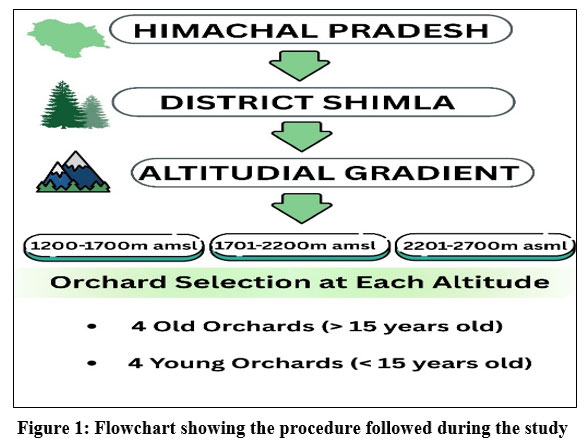
Two orchards were selected for analysis within each altitudinal gradient, categorized by age groups: those under 15 years designated as young and those beyond 15 years classified as old, with four replications for each group. The experiment was planned as a factorial randomized design, considering two factors: varying altitudinal gradients and age classes. Figure 1 illustrates the flow chart of the methodology employed in the current investigation.
 | Figure 1: Flowchart showing the procedure followed during the study
|
Quantification of apple pruned residue
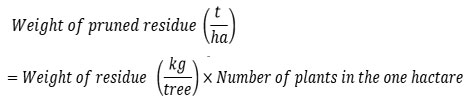
In each orchard, five apple plants were randomly selected for the quantification of woody biomass. Approximately 1,333 trees per hectare were chosen based on the prevailing spacing, as determined by the selected orchardist, specifically 2.5 × 3 meters. The quantification process occurred during the winter months (December to February). The weight of the pruned residue was calculated as follows:
Proximate Analysis
Representative samples from five trees were collected from each orchard and transported to the laboratory for characterization and evaluation to determine the energy potential of pruned wood.
Moisture Content (MC in %)
The MC was calculated using 20 g of the sample. The sample was subjected to oven drying for 24 hours at a temperature of 104°C to obtain the over-dry weight in accordance with the ASTM D2016-2512 standard.

where,
Wi is the initial weight of the sample.
Wf is the final weight of the sample.
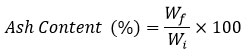
Ash Content (%)
One gram of the sample was placed into a pre-weighted crucible without a lid. This was carried out using the ASTM D-5142 procedure.12
where,
Wi is the initial weight of the sample
Wf is the final weight of the sample
Volatile matter (%)
The analysis of volatile matter was conducted in accordance with the ISO 562/197410 standards. Initially, the samples were weighed and then exposed to dry thermal treatment within a muffle furnace at a temperature of 550 ± 25°C for 10 minutes. Subsequent to the extraction phase, specimens were positioned within desiccators for cooling. This was followed by an additional repeat of the heating process, after which the specimens underwent another cooling period in the desiccators. An analytical balance from Mettler Toledo was utilized to ascertain the final weights of the samples, while the percentages of volatile matter were calculated according to the specified methodology.

where,
Zi is the initial weight of the sample
Zf is the final weight of the sample
Fixed Carbon (%)
Fixed carbon (FC) refers to the inorganic matter impurities that remain after the combustion of the biomass. It was determined by using the relationship as shown in the equation12

where,
% AC is the percentage of ash content
% VM is the percentage of volatile matter
Calorific value (kcal/kg)
The calorific value of the sample was determined using a bomb calorimeter (Model Toshiwal DT-100), which operates on the fundamental principle that thermal energy released during the combustion of the sample is equivalent to the thermal energy absorbed by the calorimeter system.
Energy Potential (MJ/t)
The energy potential of pruned residues is calculated using the formula given in the reported literature.13

Sampling procedure for farmers’ perception of pruned residue disposal
A random sampling technique was used to select the local orchardist for collecting information on the disposal of pruned residue in the study area. In each altitude, 30 households were selected randomly. The present study is based on the primary data gathered through interviews conducted with a selection of orchardists.
The survey was conducted using a pre-tested structured questionnaire. The questions are specific to the utilization pattern of the pruned residue. The survey was conducted during the winter season.
Emission estimation of apple pruned residue
Sample collection and preparation
Residue samples from apple pruning were systematically collected across three different altitude zones within the study area. The samples obtained from each of the three altitudes were combined to form a representative composite sample. A total mass of 1 kg of the mixed biomass was utilized for the purpose of emission analysis, conducted with three replications (n=3). Biomass samples were air-dried to constant moisture content under controlled conditions (20±2°C, 45±5% RH) and stored in sealed containers prior to analysis.
Emission Analysis System
A HORIBA VA-3000 Series Multi-Component Gas Analyzer equipped with the VS-3000 Series Sample Gas Conditioning System was used for real-time gas emission measurement. The system employs Non-Dispersive Infrared (NDIR) technology for simultaneous measurement of CO, CO2, CH4, NOx, and SO2.14 Key specifications include: CO measurement range 0-200 parts per million (ppm) to 0-100 volume percent (vol%), accuracy of ±1.0% of the full scale, repeatability of ±0.5% of the full scale, and response time T90 of within 30 seconds.15
PM2.5 analysis was conducted using the TSI SidePak AM520 for real-time monitoring, alongside gravimetric analysis with 37 mm quartz fiber filters. The filters were pre-conditioned at a temperature of 900°C and weighed using a Mettler-Toledo AG285 microbalance (±0.01 mg sensitivity). The sampling flow rate was Sampling flow rate was maintained at 16.7 L/min utilizing a cyclone inlet with a particle size cut-off of 2.5 micrometers with a 2.5 um cyclone inlet.
Combustion Protocol
Systematic combustion experiments were performed in a 2.5 m³ stainless steel chamber. Each 1 kg sample was subjected to controlled combustion conditions in accordance with established protocols. The assessment of Modified Combustion Efficiency (MCE) was conducted.16
Energy content was determined using Parr 6300 Automatic Isoperibol Calorimeter following ASTM D5865. Energy efficiency calculations utilized 23.46% conversion efficiency for woody biomass materials.
Scaling and Regional Calculations
After obtaining emission results for 1 kg of apple pruned residue, the average biomass generation was determined for different altitude zones based on field survey data: A1 (11.07 t/ha), A2 (10.80 t/ha), and A3 (7.33 t/ha). The regional calculations were performed using the following formula:
Regional Parameter = Laboratory Parameter (per kg) × Biomass Generated (kg/ha) × Total Area (ha)
Where:
Energy Efficiency (regional) = Energy Efficiency (per kg) × Biomass generation (kg) × Area
CO Emissions (regional) = CO Emission Factor (g/kg) × Biomass generation (kg) × Area
PM2.5 Emissions (regional) = PM2.5 Emission Factor (g/kg) × Biomass generation (kg) × Area
This scaling approach provided an assessment of environmental impact and energy potential from apple pruning residue management across different altitudinal zones and district-wide scale based on the standardized 1 kg laboratory emission data.
Statistical Analysis
Two-way analysis of variance (ANOVA) and Tukey’s test were used to compare the mean difference by taking the altitude and age of the tree as two factors. The results were reported at a 5% level of significance. Data was analyzed by using SPSS software version 16.
Results
The data illustrated in Table 1 indicate that the pruned wood residue, quantified on a dry weight basis in apple orchards, exhibited notable variation in relation to both altitude and the age of the trees. The recorded weight of pruned wood at lower altitudes (1200-1700 m) was 8.16 kg /tree, which is comparable to the residue observed at middle altitudes, measuring 8.06 kg/tree (1701-2200 m). In contrast, higher altitudes (2201-2700 m) yielded a lower weight of 5.50 kg /tree. In the analysis of various age classes, it was observed that older orchards produced a greater quantity of pruned wood, averaging 8.86 kg/tree, in contrast to younger orchards, which yielded 5.63 kg/tree. A non-significant interaction was observed between altitude and age classes. The maximum pruned biomass observed was 11.07 t/ha at lower altitudes, which was comparable to the biomass produced at middle altitudes, recorded at 10.80 t/ha. In contrast, the biomass generated at higher altitudes (2201-2700 m) was significantly lower, measuring at 7.33 t/ha. In various age categories, the yield was observed to be highest in older orchards, measuring 11.96 t/ha, in contrast to younger orchards, which recorded a yield of 7.51 t/ha.
Proximate analysis of apple pruned residue
The data shown in Table 1 revealed that the moisture content of pruned residue in apple orchards exhibited considerable variation in relation to the altitude of the trees and their age, while the interaction between these factors was determined to be statistically non-significant. The highest moisture content observed in pruned biomass was 43.37%, occurring at lower altitudes ranging from 1200 to 1700 meters. This value was significantly different from the moisture content recorded at both higher altitudes and the minimum moisture content of 32.87%, which was found at altitudes between 2201 and 2700 meters. The moisture content at middle altitudes, measured at 35.87% within the range of 1701 to 2200 meters, was statistically comparable to that of the higher altitudes. In various age categories, the observed maximum was 39.50% in young orchards, while the minimum recorded was 35.25% in older orchards. The analysis revealed that the interaction between altitude and age did not yield statistically significant results. The findings illustrated in Table 1 indicate that the ash content, volatile matter, and fixed carbon of pruned residue remained consistent across different ages and elevations. The ash content of pruned residue exhibited a range of 3.00 to 3.50, while the volatile matter demonstrated variability from 74.45 to 78.00%. Additionally, the fixed carbon content was observed to range from 18.75 to 21.75% within the apple orchards of the study area.
Calorific value and energy potential of pruned wood residue
The calorific value of pruned wood from apple orchards exhibited considerable variation related to the age of the orchard. The data indicated that the energy content was greater in older orchards, measuring 18.95 MJ/kg, compared to younger orchards, which recorded 17.20 MJ/kg. The values exhibited a range from 16.85 to 19.94 MJ/kg. The findings illustrated in Table 1 indicate that the energy potential of pruned residue in apple orchards exhibits considerable variation with both altitude and the age of the trees. The maximum energy potential recorded was 198.46 MJ/t at lower altitudes (1701-2200 m), which is comparable to the pruned wood from middle altitudes, exhibiting a value of 195.41 MJ/t within the same elevation range. A notably minimal energy potential of 138.01 MJ/t was recorded at elevated altitudes ranging from 2201 to 2700 meters. In a comparative analysis of various age groups, the energy content was observed to be greater in the pruned wood of older orchards, measuring 225.28 MJ/t, as opposed to 129.30 MJ/t in younger orchards. Furthermore, the analysis revealed that the interaction between altitude and age did not reach statistical significance.
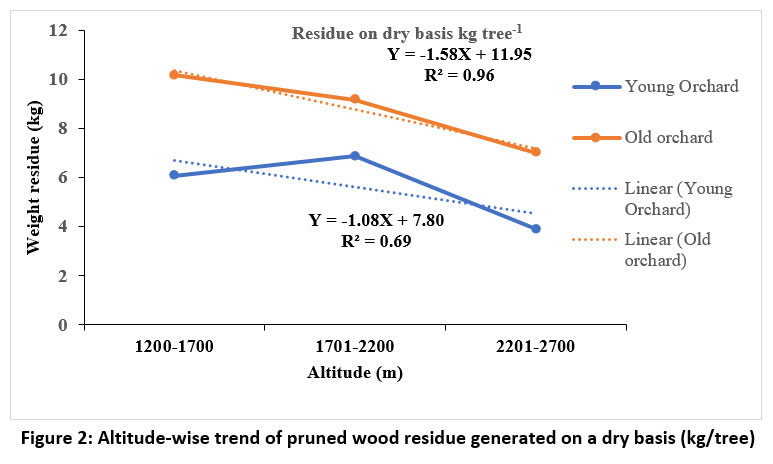 | Figure 2: Altitude-wise trend of pruned wood residue generated on a dry basis (kg/tree).
|
Analysis of Fig. 2 indicates an opposite relationship between pruned wood generation and altitude, evident in both young and mature orchards. Notably, in the mature orchard, a substantial decrease (R2=0.94) of 1.58 kg/tree was recorded with each 500 m increase in altitude. Similarly, a notable decreasing trend (R2=0.69) of approximately 1.08 kg/tree was recorded with each increment of 500 m in altitude within young orchards.
Table 1: Altitude-wise pruned residue generation, proximate analysis, calorific value and energy potential in orchards of different ages
Parameters Variables | Residue generation | Proximate analysis (%) | Calorific value | Energy potential | ||||
(kg/tree) | (t/ha) | Moisture content | Ash content | Volatile matter | Fixed carbon | (MJ/kg) | (MJ) | |
A1 | 8.16a | 11.07b | 43.37 | 3.33 | 77.25 | 19.12 | 17.69 | 198.47d |
A2 | 8.06a | 10.80b | 35.87c | 3.20 | 75.88 | 20.82 | 18.05 | 195.41d |
A3 | 5.50 | 7.33 | 32.87c | 3.12 | 75.58 | 20.83 | 18.47 | 138.01 |
Y | 5.63 | 7.51 | 39.50 | 3.25 | 77.06 | 19.77 | 17.20 | 129.31 |
O | 8.86 | 11.96 | 35.25 | 3.19 | 75.41 | 20.75 | 18.95 | 225.28 |
A1Y | 6.14 | 8.10 | 46.75 | 3.50 | 78.00 | 19.50 | 16.85 | 136.43 |
A1O | 10.19 | 14.05 | 40.00 | 3.17 | 76.50 | 18.75 | 18.53 | 260.51 |
A2Y | 6.80 | 9.18 | 38.00 | 3.25 | 76.77 | 19.90 | 17.74 | 162.57 |
A2O | 9.32 | 12.42 | 32.87 | 3.15 | 75.00 | 21.75 | 18.36 | 228.25 |
A3Y | 3.95 | 5.26 | 33.75 | 3.00 | 76.42 | 19.92 | 17.00 | 88.93 |
A3O | 7.06 | 9.41 | 32.00 | 3.25 | 74.75 | 20.75 | 19.94 | 187.09 |
P value | ||||||||
Altitude | 0.00 | 0.00 | 0.04 | 0.79 | 0.29 | 0.16 | 0.62 | 0.00 |
Age | 0.00 | 0.00 | 0.07 | 0.82 | 0.08 | 0.24 | 0.01 | 0.00 |
Altitude * Age | 0.30 | 0.10 | 0.66 | 0.66 | 0.99 | 0.34 | 0.36 | 0.09 |
A1 = Lower altitudes (1200-1700 m), A2 = Middle altitudes (1701-2200 m), A3 = Higher altitudes (2201-2700 m), Y= Young orchard, O = Old orchard. a,b,c,d depict at par values. Mean difference is significant at a 0.05 level.
Utilization pattern of pruned wood residue:
The farmer's observation regarding the disposal pattern of the pruned residue is illustrated in Fig. 3. The data indicated that at lower altitudes (1200-1700 m), 26% of orchardists are employing pruned residue as fuelwood. This is followed by open burning and livestock feeding, each at 19.5%, grafting at 15.6%, composting at 14.3%, and mulching at 5.2%. In the middle altitude range of 1701-2200 meters, a significant proportion of orchardists, specifically 26.6%, engage in the practice of open burning for residue disposal, followed by the utilization of residue as fuelwood at 24.1%, grafting at 19.0%, livestock feed at 16.5%, composting at 11.4%, and mulching at 2.5%. In elevated altitudes ranging from 2201 to 2700 meters, a significant proportion of orchardists, specifically 55.6%, engage in the practice of open burning for the disposal of residue. This is followed by the utilization of fuelwood at 20%, livestock feed at 8.9%, grafting at 11.1%, composting at 4.4%, and, notably, mulching at 0%.
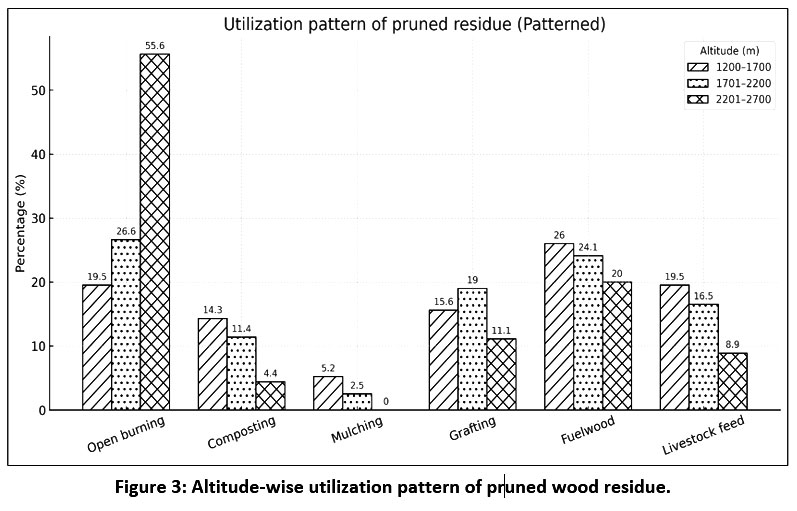 | Figure 3: Altitude-wise utilization pattern of pruned wood residue.
|
Environmental Implications of Apple Pruned Residue
The combustion performance analysis of apple wood revealed distinct characteristics in terms of efficiency and emission profiles. The combustion efficiency for 1kg of sample was determined to be 23.46%, indicating incomplete combustion conditions during the experimental trials. The particulate matter emissions, specifically PM2.5, were measured at 222.22 mg/MJ, while carbon monoxide (CO) emissions registered at 2.99 g/MJ.
Altitude-Dependent Emission Characteristics
The data illustrated in Table 2 demonstrated emission calculations for apple pruned residue, indicating notable variations across various altitudes within the study region. Three distinct altitude zones, designated as A1, A2, and A3, exhibited differences in biomass densities along with their associated emission levels. A1 exhibited the most significant biomass density, measuring 11.07 t/ha. This condition facilitated the production of 48,045 MJ/ha of usable energy, while concurrently leading to PM 2.5 emissions quantified at 10.68 kg/ha and CO emissions recorded at 143.65 kg/ha. A2 demonstrated similar biomass density levels at 10.80 t/ha, resulting in PM2.5 and CO emissions quantified at 10.42 kg/ha and 140.15 kg/ha, respectively. A3 exhibited significantly diminished values, with a biomass density of 7.33 t/ha leading to correspondingly lower emissions of 7.07 kg/ha PM2.5 and 95.12 kg/ha CO.
District-Scale Emission Assessment
The data presented in Table 3 indicate the amount of waste produced by apple orchards, derived from a comprehensive assessment of the Shimla District, which demonstrates significant waste generation across 42,315 hectares of cultivated land. The district exhibits an average pruned biomass production of 9.74 t/ha per annum, resulting in an estimated generation of 412,148 tons of apple pruning residue annually. This figure indicates a considerable biomass resource and a potential source of emissions.
Annual Emission Inventory
The comprehensive calculations of emissions across the district, utilizing an established energy efficiency rate of 23.46% alongside specific emission metrics (PM 2.5: 222.22 mg/MJ; CO: 2.99 g/MJ), indicated significant annual releases of pollutants. The total annual emissions of PM2.5 resulting from the combustion of apple pruned residue amounted to 397.5 tons, whereas the emissions of carbon monoxide (CO) were recorded at 5,348 tons. The emissions in question constitute a notable factor in the regional air pollution landscape, especially evident during the post-harvest burning period.
Table 2: Altitude-wise energy generation and pollutant emission
Altitude | Biomass (t/ha) | Useful Energy (MJ/ha) | PM2.5 Emissions (Kg/ha) | CO Emissions (Kg/ha) |
A1 | 11.07 | 48,045 | 10.68 | 143.65 |
A2 | 10.80 | 46,873 | 10.42 | 140.15 |
A3 | 7.33 | 31,813 | 7.07 | 95.12 |
Table 3: Total emission of pollutants in Shimla district
Total APR (t/ha) | CO (tons) | CO (kg/ha) | PM2.5 (kg/ha) | PM2.5 (Tons) |
29. 20 | 5,348 | 126.39 | 9.39 | 397.5 |
Discussion
Residue generation
The dry pruned residue in apple orchards exhibited considerable variation with regard to both altitude and the age of the trees. A negative correlation exists between the generation of pruned residue and altitude, indicating that as altitude increases, the amount of pruned residue produced diminishes. As altitude increases, there is a corresponding reduction in the duration of the vegetative period, and the growth of trees is inhibited at higher elevations.17 The significant biomass accumulation observed at lower altitudes can be ascribed to the comparatively warmer and more humid climatic conditions when juxtaposed with those at higher altitudes. This environmental context facilitates exponential growth and enhances the accumulation of photosynthates.18,19 It was also observed that both the average height of trees and the annual rates of shoot growth exhibited a decline with increasing elevation. This illustrates the impact of high-altitude environmental factors, such as lowered temperatures, limitations on water availability due to cold, restricted access to nutrients, and exposure to strong winds, on critical indicators of tree growth. Nevertheless, it was observed that older orchards exhibited a greater accumulation of maximum residue compared to their younger counterparts. This phenomenon may be attributed to an increased likelihood of diseases and the presence of infected branches, which potentially enhance residue production in mature orchards.20 Research indicates that the accumulation of biomass within tree structures, including stems, limbs, and foliage, exhibits a positive correlation with the age of the tree. Specimens of greater age demonstrated significantly elevated biomass metrics in comparison to their younger counterparts. The current study was corroborated by research focusing on apple crops,10 which determined that the pruned biomass ranged from 7.23 to 9.08 kg/tree.21 The annual pruned biomass was reported to be within the range of 3.5 to 8.5 Mg/ha.22 The measured quantity of pruned residue was observed to fall within the range of 0.7 to 9.0 t/ha.
Moisture content
The moisture content of pruned residue in apple orchards varied significantly with the altitude. The high moisture content in pruned biomass was recorded in lower altitudes than in higher altitudes. Hence, the high moisture content might be attributed to the wet and humid climate in lower altitudes than in higher altitudes. The moisture content of crop residue varies depending on the type of crop residue and climatic conditions, i.e., in a humid environment, the residue will retain more moisture than in an arid environment.23 However, the moisture content was in line with the reports for apple trees.21,22 The moisture content was 32.14%13 and 37.66%.24
Ash content
The ash content in apple pruned residue varied between 3.00-3.50%.13 also found an ash content of 3.25%. It was reported that the ash content was much higher in lower-age trees compared to mature trees.25
Volatile Matter
The Volatile matter in apple pruned residue varied between 74.45% and 78.00%. The volatile matter in the apple pruned residue was 79.21%13 and 73.50 ± 10.29%.8
Fixed carbon
The fixed carbon in apple-pruned residues varied between 18.75 and 21.75%. The fixed carbon in apple-pruned residues was obtained as 17.54%13 and 18.25 ± 2.29%.10
Calorific value and energy potential of pruned wood residue
The measurement was elevated in the old orchard compared to the younger one. The findings align with the previously conducted study, which similarly indicated that the calorific value of mature trees exceeds that of lower-age trees.25 The energy potential of pruned residue in apple orchards exhibited considerable variation in relation to both altitude and the age of the trees. The observed decrease in energy potential in orchards located at higher altitudinal ranges may be attributed to the interaction between calorific value and the quantity of pruned residue produced. In various age groups, the increased energy potential observed in older orchards may be ascribed to a greater biomass accumulation and an elevated calorific value of the pruned residues. The mass of individual tree components, including the trunk, branches, and leaves, exhibited an increase with the age of both Scots pine and Norway spruce species. Specimens of advanced age exhibited markedly higher biomass values in comparison to their younger counterparts; however, it is noteworthy that the leaf biomass of the oldest group did not show a significant difference from that of the mature group.
Utilization Pattern
The predominant disposal methods for apple pruned residue in the Shimla district included open burning, fuelwood utilization, livestock feeding, composting, mulching, and grafting. In the context of various waste disposal methodologies, it was observed that open burning emerged as the most prevalent practice within the region. It was observed that 30% of farmers engaged in the chipping of pruned residues, while 37.5% employed open burning as a method of disposal, and 2.5% utilized these residues for livestock feeding.26 In various global regions, the predominant methodology entails the eradication of residual wood materials via combustion or their conversion into chips for the purpose of resource recovery.27 Research indicates that the management of waste in apple orchards encompasses various practical solutions and methodologies, including open-field incineration, immediate mulching, and waste burial. These practices lead to considerable ecological risks and social drawbacks.28 It has been observed that India functions as a significant entity in the agricultural sector, characterized by continuous cultivation throughout the year. However, it encounters a considerable challenge in the management of the substantial volume of crop residue produced. In the lack of viable, long-term solutions, a significant amount of this residue is incinerated each year. The extensive practice of burning significantly exacerbates air pollution, leading to various health issues and intensifying the effects of global warming. Nevertheless, the implementation of sustainable techniques such as composting, briquette and biochar production, and mechanization presents a promising opportunity for the transformation of agricultural waste into a valuable resource.
Combustion efficiency
The observed combustion efficiency of 23.46% for apple wood is significantly lower than the optimal values reported in the literature. Previous studies have demonstrated that well-controlled apple wood combustion can achieve much higher efficiencies. For instance, as per a study, it was found that optimized air supply conditions for apple tree wood burning could achieve modified combustion efficiencies of up to 92.4±2.5% under controlled laboratory conditions.29 The substantial difference between our results and these optimal values suggests suboptimal combustion conditions, which may be attributed to factors such as inadequate air supply, moisture content, or improper fuel-to-air ratios.
The low efficiency observed in this study aligns with patterns identified in biomass combustion research, where incomplete combustion conditions typically result in reduced energy conversion and increased pollutant emissions. Studies on various wood species have shown that combustion efficiency is strongly influenced by operational parameters, with moisture content being a critical factor.30
Particulate Matter Emissions (PM2.5)
The PM2.5 emission factor of 222.22 mg/MJd represents a relatively high level of fine particulate matter release. This value is considerably elevated compared to optimized combustion scenarios reported in the literature. The PM2.5 emission factors were as low as 0.13±0.01 g/MJ under optimal secondary air supply conditions for apple tree wood, which is substantially lower than our observed values when converted to comparable units.29
The high PM2.5 emissions observed in this study are consistent with the correlation between incomplete combustion and particulate matter formation. Research has demonstrated that PM2.5 emissions increase significantly under poor combustion conditions, primarily due to the incomplete oxidation of organic compounds.31 The elevated particulate emissions are particularly concerning from an environmental and health perspective, as PM2.5 particles can penetrate deep into the respiratory system and have been associated with various adverse health effects.
Wood combustion has been identified as a major source of PM2.5 pollution in many regions. Studies indicate that residential wood combustion can account for 51% of total PM2.5 emissions in some areas, despite representing only a small fraction of total energy consumption.32 The high PM2.5 values observed in our study emphasize the importance of optimizing combustion conditions to minimize environmental impact.
Carbon Monoxide Emissions
The CO emission factor of 2.99 g/MJd indicates substantial incomplete combustion, as carbon monoxide is primarily formed when insufficient oxygen is available for complete oxidation of carbon to CO2. This emission level is considerably elevated compared to well-optimized biomass combustion systems. It was demonstrated that modern biomass stoves with optimized combustion can achieve CO emissions below 500 mg/MJ, representing more than a five-fold reduction compared to the values observed in this study.33 The relationship between CO emissions and incomplete combustion is well-established in biomass burning literature. Studies have shown direct correlations between CO emissions and other products of incomplete combustion, including PM2.5 and organic compounds.34 Under conditions of insufficient oxygen supply or poor mixing, the combustion process favors the formation of CO over complete oxidation to CO2, simultaneously resulting in increased particulate emissions. It was demonstrated that optimization of secondary air injection in wood-burning cookstoves can significantly reduce CO emissions while improving overall combustion efficiency.31,35 The study showed that proper air supply management could reduce CO concentrations by up to 70% compared to conventional operation, highlighting the critical importance of combustion optimization.
Altitude-Related Emission Variations
The altitude-dependent variations in biomass density and emissions indicate intricate interactions among topography, climate, and agricultural productivity. Prior research in the Himalayan region has revealed considerable spatial discrepancies in particulate matter concentrations at varying elevations, with principal component analysis attributing around 28% of total PM emissions to biomass burning. The elevated biomass densities noted at intermediate altitudes (A1 and A2), in contrast to higher elevations (A3), presumably indicate excellent growth conditions and effective orchard management at these altitudes.
Health and Environmental Implications
The calculated annual emissions of 397.5 tons of PM2.5 from apple orchard residue burning in Shimla district represent a significant public health concern. Epidemiological studies have shown PM2.5 as a significant risk factor for cardiovascular and respiratory disorders, as tiny particles can infiltrate the lungs and circulation. In India, PM2.5 exposure is recognized as the third foremost risk factor for mortality, accounting for about 1 million premature deaths per year. Research in South Asian megacities has shown that biomass combustion can contribute 40.2% of total PM2.5 levels during non-monsoon months, underscoring the significant role of agricultural residue incineration in regional air pollution. The emissions from apple orchards exacerbate this issue, particularly impacting the health of both rural and urban residents in the area.
The residue from pruned apple trees may significantly contribute to global warming and climate change if not appropriately handled or utilized. To alleviate its potential effects, the pruned residue may be repurposed into compact biofuel, specifically briquettes and pellets made from loose biomass and biochar derived from hardwood residue. This provides substantial contributions to multiple Sustainable Development Goals (SDGs). It promotes Climate Action (SDG 13) by sequestering carbon and reducing greenhouse gas emissions. Improving terrestrial ecosystems (SDG 15) through enhanced soil health (utilizing biochar as a fertilizer) and effective waste management promotes biodiversity (biofuel derived from pruning debris). The manufacture of briquettes from pruned biomass offers Affordable and Clean Energy (SDG 7) and mitigates air pollution, supporting Sustainable Cities and Communities (SDG 11). This method promotes a circular economy, aligning with Responsible Consumption and Production (SDG 12). Finally, it underscores Partnerships for the Goals (SDG 17) via joint initiatives among diverse stakeholders. These strategies embody a comprehensive approach to attaining sustainability and bolstering community resilience. This will also fall under the Clean Development Mechanism (CDM) of the Kyoto Protocol. The charcoal will be employed to alleviate soil contamination and purify water in rural regions. Therefore, effective management and usage of this valuable resource can only be achieved by conducting more comprehensive experimentation and research in this area. The present study was limited to a small sample size in a single district of Himachal Pradesh, and the seasonal variability in residue generation was not comprehensively addressed. Future research should encompass broader geographical regions across different apple-growing states, investigate the temporal dynamics of residue production throughout the year, and evaluate the techno-economic feasibility of large-scale bioenergy conversion systems. Additionally, the potential for value-added applications such as briquetting biochar and mulching production should be explored, where briquetting involves compressing apple pruning residues into dense fuel blocks for efficient combustion, while biochar production through controlled pyrolysis creates a carbon-rich material suitable for soil amendment and carbon sequestration while mulching involves using shredded pruning residues as soil cover to enhance moisture retention, suppress weeds, and improve soil organic matter content." Furthermore, life cycle assessment studies and comprehensive environmental impact evaluations of alternative disposal methods warrant further investigation to develop sustainable waste management strategies.
Conclusion
This study highlights the significant variation in apple pruned residue generation and its characteristics based on altitude and tree age in Shimla's apple orchards. Pruned residue was higher in lower altitudes due to favorable climatic conditions and greater in older orchards due to disease incidence and larger biomass. The pruned biomass ranged between 3.5–9.0 Mg/ha, with a moisture content of up to 37.66%, volatile matter around 74.45–78.0 %, and calorific value higher in mature trees. However, current utilization is unsustainable, with open burning being the predominant practice, contributing significantly to pollution. Annual emissions were estimated at 397.5 tons of PM2.5, with CO emissions at 2.99 g/MJ and PM2.5 at 222.22 mg/MJd, far exceeding optimized combustion levels.
Acknowledgment
The authors wish to thank the Department of Environmental Science, Dr YS Parmar University of Horticulture and Forestry, Nauni – Solan, Himachal Pradesh, India, for making the laboratory facilities available.
Funding Sources
The author(s) received no financial support for the research, authorship, and/or publication of this article
Conflict of Interest
The authors do not have any conflicts of interest
Data Availability Statement
All the data used in the paper are presented in the form of tables.
Ethics Statement
This research did not involve human participants, animal subjects, or any material that requires ethical approval
Informed Consent Statement
This study did not involve human participants, and therefore, informed consent was not required.
Permission to reproduce material from other sources
Not Applicable
Author Contributions
All authors contributed to the study:
Vipasha Sharma: Material preparation, data collection and analysis.
Dr. Rajeev Kumar Aggrawal: Conception, design and analysis and review.
Dr. Pratima Vaidya: Data analysis, Interpretation of results and reviews.
Dr. Hukam Chand Sharma: Interpretation of results and reviews.
Dr Ghanshyam Agrawal, Interpretation of results and reviews
References
- El-Fawal EM, El Naggar AM, El-Zahhar AA, Alghandi MM, Morshedy AS, El Sayed HA. Biofuel production from waste residuals: comprehensive insights into biomass conversion technologies and engineered biochar applications. RSC Adv. 2025;15(15):11942-11974.
CrossRef - Xu Y, Huang Z, Ou J, Jia G, Wu L, Liu H, Lu M, Fan M, Wei J, Chen L, et al. Near-real-time estimation of hourly open biomass burning emissions in China using multiple satellite retrievals. Sci Total Environ. 2022;817:152777.
CrossRef - Koski R, Jacobi WR. Tree pathogen survival in chipped wood mulch. J Arboric. 2004;30(3):165-171.
CrossRef - Kannepalli S, Strom PF, Krogmann U, Subroy V, Gimenez D, Miskewitz R. Characterization of wood mulch and leachate/runoff from three wood recycling facilities. J Environ Manage. 2016;182:421-428. doi:10.1016/j.jenvman.2016.07.093
CrossRef - Dey A, Thomson RC. India's biomethane generation potential from wastes and the corresponding greenhouse gas emissions abatement possibilities under three end use scenarios: electricity generation, cooking, and road transport applications. Sustainable Energy Fuels. 2023;7(1):209-241.
CrossRef - de Meira AM, Nolasco AM, de Souza EC, de Souza MP, Pereira AKS, Ucella-Filho JGM, Dias Júnior AFD. 2024. Integrated municipal management of waste from tree pruning and removal. Urban Forestry & Urban Greening. 94:128238. https://doi .org/10.1016/j.ufug.2024.128238
CrossRef - Prando D, Boschiero M, Campana D, Gallo R, Vakalis S, Baratieri M, Zerbe S. Assessment of different feedstocks in South Tyrol (Northern Italy): Energy potential and suitability for domestic pellet boilers. Biomass Bioenergy. 2016;90:155-162. doi:10.1016/j.biombioe.2016.03.039
CrossRef - Dyjakon A, Gebresenbet G, Bosona T, Adamczyk F. Economic analysis of the collection and transportation of pruned branches from orchards for energy production. Drewno. 2020;63.
CrossRef - Wiinikka H, Gebart R, Boman C, Bostrom D, Ohman M. Influence of fuel ash composition on high temperature aerosol formation in fixed bed combustion of woody biomass pellets. Fuel. 2007;86:181-193. doi:10.1016/j.fuel.2006.07.001
CrossRef - Bilandzija N. Energy potential of fruit tree pruned biomass in Croatia. Span J Agric Res. 2012;10(2):292-298. doi:10.5424/sjar/2012102-126-11
CrossRef - Obernberger I, Thek G. Physical characterization and chemical composition of densities biomass fuels with regard to their combustion behavior. Biomass Bioenergy. 2004;27:653-669. doi:10.1016/j.biombioe.2003.07.006
CrossRef - Debdoubi J, Cano R, Kiveka E, Colacio E. Production of fuel briquettes from esparto partially pyrolyzed. Energy Convers Manage. 2005;46:1877-1884. doi:10.1016/j.enconman.2004.09.005
CrossRef - Brand MA, Jacinto RC. Apple pruning residues: Potential for burning in boiler systems and pallet production. Renew Energy. 2020;152:458-466. doi:10.1016/j.renene.2020.01.037
CrossRef - Dinh TV, Ahn JW, Choi IY, Song KY, Chung CH, Kim JC. A review on non-dispersive infrared gas sensors: Improvement of sensor detection limit and interference correction. Sens Actuators B. 2017;243:684-698.
CrossRef - Tan Q, Tang L, Yang M, Xue C, Zhang W, Liu J, Xiong J. Three-gas detection system with IR optical sensor based on NDIR technology. Opt Lasers Eng. 2015;74:103-108.
CrossRef - Ward DE, Radke LF. Emissions measurements from vegetation fires: a comparative evaluation of methods and results. Fire Environ. 1993:53-76.
- Zenginbal H, Ozcan M. Effect of altitude on growth-development and fruit quality attributes of kiwifruit (Actinidia deliciosa Planch) cultivation. Pak J Agric Sci. 2018;55(4). doi:10.21162/PAKJAS/18.5417
- Gajanayake B, Reddy KR, Shankle MW, Arancibia RA, Villordon AO. Quantifying storage root initiation, growth, and developmental responses of sweet potato to early season temperature. Agron J. 2014;106:1795-1804. doi:10.2134/agronj14.0067
CrossRef - Wang Y, Cufar K, Eckstein D, Liang E. Variation of maximum tree height and annual shoot growth of Smith fir at various elevations in the Sygera Mountains, southeastern Tibetan Plateau. PLoS One. 2012;7(3):e31725. doi:10.1371/journal.pone.0031725
CrossRef - Hu M, Lehtonen A, Minunno F, Makela A. Data for "age effect on tree structure and biomass allocation in Scots pine (Pinus sylvestris L.) and Norway spruce (Picea abies [L.] Karst.)". Zenodo Repository. 2020;V1. doi:10.5281/zenodo.3940310
CrossRef - Dyjakon A, den Boer J, Bukowski P, Adamczyk F, Frackowiak P. Wooden biomass potential from apple orchards in Poland. Drewno. 2016;59(198). doi:10.12841/wood.1644-3985.162.09
CrossRef - Magagnotti N, Pari L, Picchi G, Spinelli R. Technology alternatives for tapping the pruning residue resource. Bioresour Technol. 2013;128:697-702. doi:10.1016/j.biortech.2012.10.149
CrossRef - Bagrecha S, Melavanki MS, Fiskey VV, Dadhich DK, Rai AK, Singh SV, Singh Y. Scenario of crop residue generation and sustainable management. In: Modern Technology for Sustainable Agriculture. Cham, Switzerland: Springer Nature Switzerland; 2025:291-311.
CrossRef - Ekinci K. Utilization of apple pruning residues as a source of biomass energy: A case study in Isparta province. Energy Explor Exploit. 2011;29(1):87-107.
CrossRef - Kumar R, Pandey KK, Chandrashekar N, Mohan S. Effect of tree age on calorific value and other fuel properties of Eucalyptus hybrid. J For Res. 2010;21:514-516. doi:10.1007/s11676-010-0108-x
CrossRef - Benyei P, Cohen M, Gresillon E, Angles S, Araque-Jimenez E, Alonso-Roldan M. Pruning waste management and climate change in Sierra Magina's olive groves (Andalusia, Spain). Reg Environ Change. 2018;18:595-605. doi:10.1007/s10113-017-1230-5
CrossRef - Wang K, Nakao S, Thimmaiah D, Hopke PK. Emissions from in-use residential wood pellet boilers and potential emissions savings using thermal storage. Sci Total Environ. 2019;676:564-576.
CrossRef - Bhuvaneshwari S, Hettiarachchi H, Meegoda JN. Crop residue burning in India: policy challenges and potential solutions. Int J Environ Res Public Health. 2019;16(5):832. doi:10.3390/ijerph16050832
CrossRef - Li X, Wang S, Duan L, Hao J, Li C, Chen Y, Yang L. Particulate and trace gas emissions from open burning of wheat straw and corn stover in China. Environ Sci Technol. 2007;41(17):6052-6058.
CrossRef - Guerrero F, Yanez K, Vidal V, Cereceda-Balic F. Effects of wood moisture on emission factors for PM2.5, particle numbers and particulate-phase PAHs from Eucalyptus globulus combustion using a controlled combustion chamber for emissions. Sci Total Environ. 2019;648:737-744.
CrossRef - McDonald JD, Zielinska B, Fujita EM, Sagebiel JC, Chow JC, Watson JG. Health impacts of PM2.5 originating from residential wood combustion in four Nordic cities. BMC Public Health. 2020;22:1-14.
- Burkhard E. Introduction to special issue on residential wood combustion. J Air Waste Manag Assoc. 2022;72(7):617-618.
CrossRef - Bafver LS, Leckner B, Tullin C, Berntsen M. Particle emissions from pellet stoves and modern and old wood stoves. Biomass Bioenergy. 2011;35(8):3648-3655.
CrossRef - Elsasser M, Busch C, Orasche J, Schon C, Hartmann H, Schnelle-Kreis J, Zimmermann R. Dynamic changes of the aerosol composition and concentration during different burning phases of wood combustion. Energy Fuels. 2013;27(8):4959-4968.
CrossRef - Caubel JJ, Rapp VH, Chen SS, Gadgil AJ. Optimization of secondary air injection in a wood-burning cookstove: An experimental study. Environ Sci Technol. 2018;52(7):4449-4456.
CrossRef