Management Practices of Urban Waste in Saudi Arabia
Mirinchonme Mahongnao1
*
 and Amit Kumar2
1
Department of Environmental Studies,
Kalindi College,
University of Delhi,
India
2
Centre for West Asian Studies,
School of International Studies,
Jawaharlal Nehru University,
Delhi,
India
http://dx.doi.org/10.12944/CWE.20.2.4
Copy the following to cite this article:
Mahongnao M, Kumar A. Management Practices of Urban Waste in Saudi Arabia. Curr World Environ 2025;20(2). DOI:http://dx.doi.org/10.12944/CWE.20.2.4
Copy the following to cite this URL:
Mahongnao M, Kumar A. Management Practices of Urban Waste in Saudi Arabia. Curr World Environ 2025;20(2).
Download article (pdf)
Citation Manager
Publish History

Introduction
This paper assesses the status of urban solid waste management in Saudi Arabia, particularly the physical composition and the related technology, waste regulations, and segregation behavior. Sustainable waste management is one of the critical objectives of Vision 2030, which aims to secure environmental sustainability by reducing pollution and protecting the environment.1 The subject also aligns with sustainable development goals that promote good health and the environment. In conjunction with these, the circular economy explains the management system of prevention, reuse, reduction, and recycling. The central idea is to enhance the value of products for a longer time in a market to minimize waste generation.2 Today, many countries have incorporated the idea of a circular economy into their waste management systems. The 'Vision 2030' and the 'Middle East Green Initiative' are the Kingdom’s commitment to sustainability efforts to achieve the United Nations Sustainable Developing Goals (SDGs) targets. Implementing the concept of circular economy is one of the initiative's key objectives. This paper examines how far the Kingdom's strategies are towards sustainable waste management while seeking a technological solution to waste problems. Is the policy articulation of the Waste Management Law 2021, ‘Vision 2030’ and the Middle East Green Initiative in line with the Sustainable Development Goals (SDGs) and circular economy? What sustainable technology could be viable for the Kingdom's waste management system?
The waste management method in the Kingdom followed the conventional method of collection, transportation, dumping, and disposal. Traditionally, municipalities and waste collection companies have been responsible for the overall management of solid waste. Currently, the annual production of solid waste amounts to 15 million tons, wherein the majority of the waste produced in main cities such as Jeddah, Medina, and Mecca in the East and Damman, Hotuf, and Riyadh in the West. The annual waste generation from three cities exceeds 6x10⁶ tons.3 The per capita generation ranges from 1.5 to 1.8 kg from a population of 29 million, with 75% of the population residing in urban settlement.4 The increasing volume of waste generation in such major cities and the sudden surge of urbanization, industrialization, population, and change in lifestyle, waste management has become a challenge to the municipal authorities of the Kingdom.5 Improper or open dumping methods have directly impacted the quality of soils, water, and air, affecting the quality of the lives of the Kingdom. Such a method of waste management is prevalent in developing countries. Open landfilling is considered the most undesirable disposal method in the waste management hierarchy.6 Today, the most desirable methods include 4Rs-reuse, reduce, recycle, and recover; compaction, sanitary landfilling, composting, bio-methanation, and waste-to-energy projects.7 Various studies have highlighted the negative impacts on the environment and health stemming from the unscientific method of waste management.8-9 Such a method of waste disposal is linked to pollution and health problems such as reproductive complications, respiratory diseases, skin diseases, and even cancer.10-12
Other problems include non-segregation of waste at source, insufficient funds, unskilled workers, weak governance, inappropriate selection of technology, lack of awareness and public participation, and high dependency on imported technology. Therefore, this study addresses these challenges and propose to develop a resilient and appropriate waste management system in the Kingdom to minimize waste production and increase the waste reuse and recycling rate.13
Materials and Methods
This study employs a qualitative, literature-based research methodology to critically analyze the solid waste management issues in Saudi Arabia. The sources of data collection were scholarly databases, specifically Google Scholar and Scopus, primarily to identify and synthesize existing literature pertaining to current waste management practices, policies, technological applications, and segregation within the waste management system.
The framework of this study is primarily tailored in key national sustainability and legal documents, including Saudi Arabia's ‘Vision 2030’ and ‘Vision 2040’, the Saudi Green Initiative, and the Waste Management Law 2021. Vision 2030 outlines ambitious targets for waste diversion (100% solid waste, 60% construction waste, and 60% hazardous waste from landfilling), aiming to establish a circular economy model where resources will be continuously recirculated in the market.14 The Saudi Green Initiative emphasizes stakeholder collaboration and innovation to achieve sustainable waste management, notably targeting a 94% diversion of domestic waste in Riyadh from landfills by 2035 to mitigate harmful emissions.15 The Waste Management Law 2021 provides the legal framework, mandating waste segregation, regulating collection, transportation, and safe disposal, and prioritizing recycling and resource recovery.
The existing literature, while valuable, has largely focused on the conventional aspects of waste management in Saudi Arabia. Previous research has explored areas such as household waste composition and management,16,5 greenhouse gas emissions from solid waste,17 general solid waste management practices and opportunities,18-19 optimization of solid waste disposal,4 construction waste management,20 and the application of the Theory of Planned Behavior to solid waste management.21 However, the literature lacks in studies that holistically examine the intertwined contribution of waste regulations, technological appropriateness, and segregation strategies – the three quintessential pillars toward achieving a sustainable waste management system in the Kingdom.
This paper intended to address this research gaps and understand the current practices of waste management, identifies inherent flaws and proposes viable technological solutions, while considering the environmental context and management needs of the Kingdom. This study seeks to provide actionable insights for policymakers, government agencies, municipalities, and other relevant stakeholders in their pursuit of a more sustainable waste management system.
Results and Discussion
Solid Waste Management in Saudi Arabia
The Kingdom's waste management system primarily relies on traditional method where open dumping is a common practice, with minimal processing or treatment, resulting in low recycling and energy recovery due to heavy reliance on waste pickers for segregation. Owing to this, most wastes are diverted to landfills, causing waste havoc and environmental pollution.22 Currently, the Kingdom utilized compost and bio-methanation plants to process waste, recycling units and no incineration plants. The need for incineration plants in the Kingdom's waste management system is addressed in 'Vision 2030' and the Waste Management Law 2021, which is expected to come up later. In addition to these initiatives, the 'Vision 2040’ spearheaded by the National Center for Waste Management (NCWM), the Kingdom has targeted to divert 90% of waste from landfills, recycling (40%), composting (31%), and incineration (16%) by 2040.23
Under the umbrella of ‘Vision 2030’, the new ‘Vision 2040’ has taken progressive strides with respect to waste management. The progress indicates an 85% overall success rate for initiatives, and 93% of key performance indicators either achieved or nearing completion across various sectors, including waste management.24 The Kingdom is actively working towards its ambitious targets, with the Ministry of Environment, Water and Agriculture announcing in early 2024 a comprehensive plan to significantly increase recycling rates to 95% from a previous 3-4%, which is projected to contribute SAR 120 billion to the GDP and create over 100,000.25 The NCWM is spearheading these efforts developing strategic master plans for regional waste clusters, and promote investment climes, including significant advancements in waste-to-energy projects and digital waste tracking systems, all aimed at fostering a robust circular economy.26
Nevertheless, today, the waste in big cities is generally collected in large bins from the residential/commercial areas; it is then taken to a collection station and dumped in a landfill. The Makkah landfill received 1800-2000 tons/day and reached 3000 tons/day during Ramadan. The landfill at Buraiman in Jeddah received 1.5 million tons of waste annually27 and reached 4500 TPD during Hajj.28 The landfill of Makkah is non-engineered, and the soil is porous, making it susceptible to leachate percolation and thus contaminating groundwater and soil and attracting insects and rodents.29 The leachate comprises toxic components such as harmful organic and inorganic compounds and chemicals.30 The unscientific leachate handling contaminates soil and water bodies. As the Kingdom’s climate is hot, leachate vaporization will further increase and thus add more harmful compounds to the atmosphere. Another impact is the foul odor released from the waste decomposition from the dumping sites, affecting the nearby residents' health and environment. Anaerobic decomposition releases methane gas from landfill sites, thus increasing greenhouse gas potential and the region's temperature.31 This posed an immediate challenge to the current initiatives and targets undertaken by ‘Vision 2030’, ‘Vision 2040’, Ministry of Environment, Water and Agriculture, and NCWM to achieve waste management sustainability.
Technological Options
Composting
As presented in Table 1, the physical composition of solid waste in the Kingdom is predominantly organic, such as food, vegetable, and paper. Currently, the waste dumping sites are almost saturated, meaning that the waste is dumped in excess quantity and will reach beyond capacity in the coming years.22
Table 1: Physical Composition of solid waste in Saudi Arabia (Compiled from various sources by authors)
Waste type | Percentage (%) | Components |
Food waste | 40-51 | Food items: vegetables, leaves, fruits, peels, etc. |
Paper | 12-28 | Newspapers, magazines, tissue papers, toilet paper, etc. |
Cardboard | 7 | Food boxes, delivery/shipping boxes, milk and juice boxes, tissue boxes, shoe boxes, etc. |
Plastic | 5-17 | Polythene, bottles, plates, spoons, disposable glass, bags, wrapping films, etc. |
Glass | 3-5 | Bottles, bulbs, glassware, ceramics, etc. |
Wood | 2-8 | Wood wastes |
Textiles | 2-6 | Cloths, dippers, etc |
Metals/minerals | 2-8 | Cans, bottles, knives, aluminum foil, etc. |
The physical composition of waste in the Kingdom suggested that composting and recycling waste would be the most viable and economical solution to waste problems. Composting is a process where the organic waste is composted by microbes in the presence of oxygen, reducing the negative impacts on the environment.18
Many compost plants are installed in the Kingdom to convert organic wastes into compost for use as bio-fertilizers.32 The induction of the 1st National Regulation and Standards of Agriculture in 2011 is one example of the Kingdom's commitment to raising organic compost in the farming system.33 The compost produced from processing in local compost plants does not meet international standards and is considered poor quality32; lack of markets and the need to subsidize the compost are some of the constraints that hindered private companies' involvement, and thus preventing the composting practices on a large scale. Such constraints are primarily seen in most developing countries, including Bangladesh, India, Ghana, and Sri Lanka34; unlike in developed countries, there are clearly defined markets and standards for organic compost produced.35 Under the 'Vision 2040’, the Kingdom has targeted the landfill diversion of 90% of waste and composting of 31% by 2040.23 These targets pose a significant challenge to the Kingdom as a major proportion of waste is collected in unsegregated and mixed forms and diverted to landfills.
Anaerobic Composting
In this composting method, the organic waste is decomposed by microbes without oxygen to produce biogas (a combination of methane, hydrogen, and carbon dioxide gas).36 There has recently been increased awareness of using anaerobic composting to treat solid waste because of the development of new waste regulations wherein alternative energy sources are explored instead of fossil-based energy.37 The method is sustainable, eco-friendly, and economically beneficial.38 Biogas comprises 70% methane,39 so it is a reliable renewable energy option as it is cheaper than fossil-based energy. The Kingdom has three bio-methanation plants in Jeddah, Medina, and Makkah that have the potential to generate 87.3 MW, 29.9 MW, and 42.4 MW.5 However, one of the key challenges that the Kingdom faces today is the non-segregation of waste, which hampers the efficient operation and optimum conversion of this energy.
Nonetheless, the energy produced from this method is safe, as no harmful gases are made from this conversion process.39 Recent years have seen a massive development of anaerobic digestion worldwide, especially in developed countries like Britain, France, Germany, Italy, Japan and the USA; and India, China, Vietnam, Iran, Malaysia, Kenya, Uganda, Rwanda, Cameroon, etc. for developing countries. America presents the highest biogas production at 75% from landfills treating agricultural, biowaste, industrial, and sewage sludge, and Germany treats primarily agricultural and industrial wastes for biogas production.40
Recycling
Recycling in Saudi Arabia is still at a nascent stage. The Kingdom recycles paper, plastics, and metals between 10% and 15%.3 The recycling rate is low because of minimal segregation at the source, and it is primarily the waste pickers who segregate the waste at community dust bins. Recycling, reuse, and waste recovery have recently gained much attention in the Kingdom due to her commitment to environmental sustainability in Vision 2030, the Middle East Green Initiative and the Waste Management Law 2021. Recycling is considered the most effective method of reducing costs in waste collection, transportation, and other form of treatment.41 Recycling behavior is sorting waste into separate components for recycling and selling to waste dealers. Then, these waste materials are sent to recycling units to produce new products for consumers. The high recycling rate would help conserve the environment and resource depletion in the Kingdom. According to the World Economic Forum (2017), Germany, with 56.1%, recorded the highest recycling rate, closely followed by Austria, South Korea, and other European countries; most of the developing countries are below 20%. Under the 'Vision 2040’, the Kingdom has targeted to recycle 40% of waste by 2040. The target is challenging to the existing availability of waste management practices and resources; however, it is not impossible to achieve.42
Pyrolysis
Most of the solid waste, including plastic, ended up in landfill sites in the Kingdom. Plastic waste does not generally degrade readily as it stays in the environment for many years. The conversion of plastic waste into liquid fuel is an alternative method of plastic waste management. Pyrolysis is the thermal conversion of plastic waste into liquid fuel in a limited supply of oxygen in a temperature ranging from 300-900oC.43 Conventional recycling of plastic waste retains only a small portion of it. In such a situation, researchers have recently paid much attention to pyrolysis as an appropriate option for plastic waste management.44 The vapors produced during the burning are converted into liquid fuel after 3-4 hours of condensation. The liquid fuel produced has almost a similar value to diesel and has the potential to be used as an alternative form of diesel.45 Today, the Kingdom generates 12.33 Kb/d of plastic pyrolysis fuel, which has the potential to reach 124.31 Kb/d by 2060. This fuel production is low compared with the total production capacity of 12 Mmb/d, which is expected to increase further in future.46
Char is another by-product of pyrolysis, and it can be used as an adsorbent in wastewater treatment.47 Such a management method is prevalent in most countries, including India, China and Brazil.48 Since plastic waste generation is high in the Kingdom, pyrolysis is a viable treatment method. Disposable plastic consumption increases in the consecrated cities of Madina and Makkah because pilgrims worldwide step foot in these cities every year.29
Incineration
This method is the combustion of waste at high temperatures (800-1200oC) to produce energy.49 In many countries, incineration has become the most crucial method of waste management. However, incineration technology has failed in some developing countries, including India, because of high organic waste content, rendering them low calorific value, causing air pollution and impacting health.50 Incineration is not a viable option for the Kingdom. However, increasing numbers of researchers have given importance to incineration or gasification as an alternative to plastic and other dry waste.44 The Waste Management Law 2021 do not address the need for incineration plants. However, the NCWM, under the 'Vision 2040’ has targeted the waste diversion from landfills up to 90% and incinerate 16% of waste by 2040.23 Such a move requires enormous investments and political commitment, and it is a desired target if proper procedures and international guidelines are followed.
Engineered Landfilling
The landfills in Saudi Arabia are open land without the mechanism of leachate recovery, and this causes air pollution and groundwater contamination. However, the engineered landfill is an alternative to avoid these environmental problems. The leachate composition varies from site to site as it grows in size and age. The early leachate usually contains many volatile fatty acids.51 Engineered landfills generally have a concrete liner system to avoid contact with soil and groundwater.4 The organic content of the waste is converted into biogas through bio-methanation, which is considered renewable energy.52
In many countries, especially in developing countries, landfilling is the standard method of waste management; hence, sanitary landfilling becomes crucial in such countries, including Saudi Arabia. On the contrary, many EU member countries have achieved their 2035 target (less than 10%) of waste diverting to landfilling. For instance, in 2017, Switzerland was the only country that achieved zero landfilling, Sweden's landfilling rate was 0.44%, Denmark (0.87%), Germany (0.88%), Belgium (0.89%), Finland (0.92%), Netherlands (1.41%), Austria (2.08%), Norway (3.47%), and Luxembourg (3.91%).53 The Waste Management Law 2021 addresses the need for engineered landfilling in the waste management system of Saudi Arabia.
Challenges
Currently, the challenges to urban waste management in Saudi Arabia include a lack of skilled professionals in technological applications, inclusive and comprehensive waste regulations, public participation and awareness. Though waste composting is economical and eco-friendly, the quality of waste produced in the Kingdom does not meet international standards. The investigation of the chemical properties of 25 composts made from a local plant found many chemical components below international standards.32 They inferred that the locally produced composts were remained underdeveloped. The study made it imperative that the Kingdom adopt the procedures that assure quality compost, skilled professionals, and waste regulations support such measures.
The Waste Management Law 2021 promotes the concept of a circular economy - reduce, reuse, recover and recycle; prohibits the import of hazardous waste; introduces Extended Producer Responsibility-the idea that the producers/manufacturers are responsible for the collection of their products to augment the rate of waste recovery and recycling while they adhere to the norms and standards of the NCWM.54 Implementing this provision is still challenging in the Kingdom's waste management system.
The waste regulations in the Kingdom needs a holistic approach. The recognition of the role of waste workers/collectors and incorporation in the waste management system is essential for effective waste management. The Waste Management Law 2021 lacks the provision to provide proper direction for implementing a circular economy. Though environmental sustainability and circular economy are the key objectives of Vision 2030 and the Middle East Green Initiative, the waste management issue is not addressed on the severity it poses to the health and environment of the Kingdom. Under the Waste Management Law 2021, the NCWM has targeted to divert 90% of waste from landfills, recycle 40% of waste, compost 31%, and incinerate 16% by 2040. Targets are highly appreciative, but putting these into practice is difficult and requires a colossal investment, political commitments, and public participation.
Waste segregation at the household level is another big challenge in the Kingdom. Only a tiny amount of waste, such as paper, metal, bottles, and jars, is segregated at the household level in most urban areas for sale to waste collectors. A study found that household waste management is primarily considered the onus of the parents and the female adult. Other respondents considered the responsibility of male adults and children.55 Most respondents agreed to segregate household waste if quality transportation or segregating facilities are provided in the local vicinity.56 Another major challenge is the need for more awareness among the Kingdom's people on the ill effects on health and the environment because of the unscientific method of waste management. A study in Al-Ahsa City recommends an urgent need to raise public awareness of the necessity of public participation in waste management and in developing waste regulations.19 Another study at the university revealed that students have much lower awareness than teachers and staff.57 The lack of awareness and segregation facilities have rendered a low waste recycling rate in the Kingdom.
Opportunities
Tremendous opportunities can be created in the waste management sector in the Kingdom in terms of job creation and income generation for various stakeholders involved in the waste recycling channel, waste conversion to energy, carbon credits/taxes, and emissions trading, thereby boosting the region's economy. Organic and plastic waste comprise a significant component of waste produced in the Kingdom. As per data, 15,300 x103 tons of waste is produced annually, whereas Riyadh and Jeddah produced the maximum quantity of waste (figure 1).
During the consecrated period of Ramadan and Hajj, huge amounts of food and plastic waste are produced,58 and waste recycling from this is less than 20%.57 With inclusive waste regulations, many jobs can be created, including waste collectors/dealers, recyclers, the workforce in organic waste conversion to energy, and other jobs in the recycling industry. The Saudi government plans to invest USD10 billion from the local GDP and USD 1.75 billion from foreign direct investment to create 23,000 green jobs while reducing carbon emissions by 13 million tons. About 200,000 tons of scrap metal are sold to India, Indonesia, Japan, South Korea, Thailand, and Vietnam. Medical wastes are burned without management expertise.14
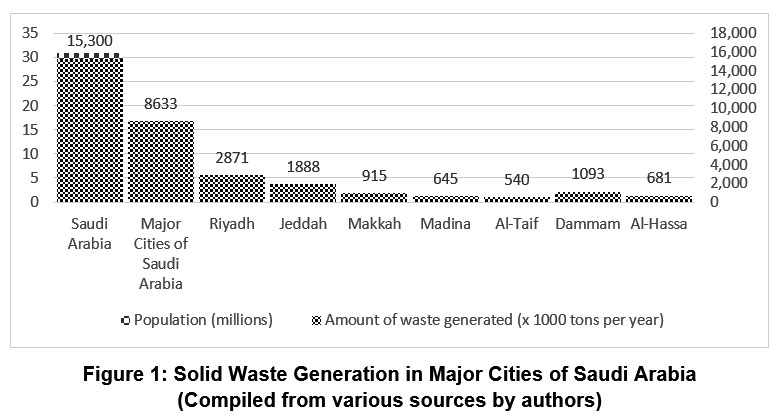 | Figure 1: Solid Waste Generation in Major Cities of Saudi Arabia (Compiled from various sources by authors)
|
Under the Middle East Green Initiative, the Kingdom is creating a regional investment fund to find technical solutions based on a planned circular economy.59 Since recycling, composting and waste-to-energy/incineration plants are lucrative, the Kingdom has enormous potential to generate revenues and energy from these projects. With the targets of 90% diversion of waste from landfills, recycling of 40%, composting of 31%, and incineration of 16%, the Kingdom can harness the optimum level of its potential and resources to its benefit, which aligns with SDGs.
Conclusion
Solid waste management presents a significant challenge for the municipalities of Saudi Arabia, driven by rapid urbanization, industrialization, population growth, and changing lifestyles. These factors contribute to an escalating volume of waste generation annually, exacerbated by increased consumption of food and related products. Despite several initiatives and targets made by kingdom, the present waste management system characterized by conventional collection, transportation, and mixed disposal in landfills, largely fails to align with the objectives of the Sustainable Development Goals, as well as the principles of a circular economy.
A key challenge within the waste management system of the kingdom is the lack of waste segregation at the source. Waste segregation is primarily performed by informal waste pickers, leading to low recycling rates and limited energy recovery. The continued reliance on landfilling for the majority of waste exacerbates environmental pollution and resource depletion. However, the kingdom possesses substantial untapped potential for waste recovery, waste-to-energy projects, and increase recycling rate. Improving waste management practices could generate significant employment opportunities for waste collection, handling, and recycling sectors.
Given the present practice of mixed waste collection and landfill disposal, coupled with ongoing population growth, there is a pressing need for the development of holistic and sustainable regulations underpinned by robust strategic planning, tailored to the unique environmental needs of the Kingdom. Based on a critical analysis of Saudi Arabia's waste management system, the following recommendations are put forward for policymakers, government agencies, municipalities, and relevant stakeholders:
Prioritize organic waste management: Given that food waste constitutes a significant portion of municipal solid waste, implementing composting and anaerobic digestion technologies would offer viable and technologically sound solutions for resource recovery.
Integrate the '4R' strategy: With high volumes of paper, plastic, and glass waste, the comprehensive incorporation of 'Reduce, Reuse, Recycle, and Recover' (4R) principles into the waste management system is imperative to boost recycling rates and divert substantial waste from landfills.
Adopt the appropriate technology: Incineration and gasification technologies may not represent optimal solutions for waste management in the Kingdom, given the predominant organic, plastic, and paper composition of the waste stream.
Formalize the roles of waste worker: The formal recognition of waste workers’ roles and integrating them into the waste management system with clear guidelines for their participation as regular employment is crucial.
Enhance public participation: practicing regular awareness campaigns across public and private institutions through diverse channels, including workshops, online platforms, social media, electronic media, and print media, is essential to foster greater public participation and behavioral change.
Acknowledgment
The authors are grateful to Jawaharlal Nehru University for giving access to articles, books, and other resources related to the research topic.
Funding Sources
The author(s) received no financial support for the research, authorship, and/or publication of this article.
Conflict of Interest
The authors do not have any conflict of interest.
Data Availability Statement
This statement does not apply to this article.
Ethics Statement
This research did not involve human participants, animal subjects, or any material that requires ethical approval
Informed Consent Statement
This study did not involve human participants, and therefore, informed consent was not required.
Permission to reproduce material from other sources
Not Applicable
Author Contributions
Mirinchonme Mahongnao: Data collection, analysing and writing the original draft.
Amit Kumar: Conceptualization, reviewing, editing, supervision and final approval of the original draft.
References
- Grand S., Wolff K. Assessing Saudi Vision 2030: A 2020 review. Atlantic Council. 2020; 17.
- Malinauskaite J., Jouhara H., Czajczynska D., Stanchev P., Katsou E., Rostkowski P., Spencer N. Municipal solid waste management and waste-to-energy in the context of a circular economy and energy recycling in Europe. Energy. 2017; 141: 2013-2044. https://doi.org/10.1016/j.energy.2017.11.128.
CrossRef - Khan M. S. M., Kaneesamkandi Z. Biodegradable waste to biogas: renewable energy option for the Kingdom of Saudi Arabia. International Journal of Innovation and Applied Studies. 2013; 1: 101-113.
- Demirbas A., Alamoudi R. H., Ahmad W., Sheikh M. H. Optimization of municipal solid waste (MSW) disposal in Saudi Arabia. Energy Sources, Part A: Recovery, Utilization, and Environmental Effects. 2016; 38(13): 1929-1937. https://doi.org/10.1080/15567036.2015.1034385.
CrossRef - Radwan N., Khan N. A., Elmanfaloty, R. A. G. Optimization of solid waste collection using RSM approach, and strategies delivering sustainable development goals (SDG's) in Jeddah, Saudi Arabia. Scientific reports. 2021; 11(1): 1-12.
CrossRef - Mahini A. S. and Gholamalifard M. Siting MSW landfills with a weighted linear combination methodology in a GIS environment. International Journal of Environmental Science & Technology. 2006; 3(4): 435-445.
CrossRef - Ayilara M. S., Olanrewaju O. S., Babalola O. O., Odeyemi O. Waste management through composting: Challenges and potentials. Sustainability. 2020; 12(11): 4456. https://doi.org/10.3390/su12114456.
CrossRef - Rushton L. Health hazards and waste management. British medical bulletin. 2003; 68(1): 183-197. https://doi.org/10.1093/bmb/ldg034.
CrossRef - Minichilli F., Bartolacci S., Buiatti E., Pallante V., Scala D., Bianchi F. A study on mortality around six municipal solid waste landfills in Tuscany Region. Epidemiologia e prevenzione. 2005; 29(5-6): 53-56.
- Upton A. C., Kneip T., Toniolo P. Public health aspects of toxic chemical disposal sites. Annual review of public health. 1989; 10(1): 1-25.
CrossRef - Knox E. G. Childhood cancers, birthplaces, incinerators and landfill sites. International Journal of Epidemiology. 2000; 29(3): 391-397. https://doi.org/10.1093/ije/29.3.391.
CrossRef - Vrijheid M. Health effects of residence near hazardous waste landfill sites: a review of epidemiologic literature. Environmental health perspectives. 2000; 108: 101-112. https://doi.org/10.1289/ehp.00108s1101.
CrossRef - Memon, M. A. 2010. Integrated solid waste management based on the 3R approach. Journal of Material Cycles and Waste Management, 12(1), 30-40.
CrossRef - International Trade Administration. Saudi Arabia & environmental technologies. 2020. https://www.trade.gov/market-intelligence/saudi-arabia-environmental-technologies
- Alsarhan A.N., Zatari T.M. Fourth National Communication: Kingdom of Saudi Arabia. Submitted to the United Nations Framework Convention on Climate Change (UNFCCC). 2022. https://unfccc.int/sites/default/files/resource/7123846_Saudi%20Arabia-NC4-1-Fourth%20National%20Communication%20NC4%20 Kingdom%20of%20Saudi%20Arabia%20 March%202022.pdf
- Hakami B. A., Seif E. S. S. A. Household solid waste composition and management in Jeddah city, Saudi Arabia: A planning model. International Research Journal of Environment Sciences. 2015; 4(1): 1-10.
- Rahman M. M., Rahman S. M., Rahman M. S., Hasan M. A., Shoaib S. A., Rushd S. Greenhouse Gas Emissions from Solid Waste Management in Saudi Arabia—Analysis of Growth Dynamics and Mitigation Opportunities. Applied Sciences. 2021; 11(4): 1737. https://doi.org/10.3390/app11041737.
CrossRef - Radwan N., Mangi S. A. Municipal solid waste management practices and opportunities in Saudi Arabia. Engineering, Technology & Applied Science Research. 2019; 9(4): 4516-4519.
CrossRef - Gharaibeh E. S., Haimour N. M., Akash B. A. Evaluation of current municipal solid waste practice and management for Al-Ahsa, Saudi Arabia. International Journal of Sustainable Water and Environmental System. 2011; 2(2): 103-110. DOI: 10.5383/swes.02.02.006.
- Ouda O. K. M., Peterson H. P., Rehan M., Sadef Y., Alghazo J. M., Nizami A. S. A case study of sustainable construction waste management in Saudi Arabia. Waste and Biomass Valorization. 2018; 9(12): 2541-2555.
CrossRef - Soomro Y. A., Hameed I., Bhutto M. Y., Waris I., Baeshen Y., Al Batati B. What influences consumers to recycle solid waste? An application of the extended theory of planned behavior in the Kingdom of Saudi Arabia. Sustainability. 2022; 14(2): 998. https://doi.org/10.3390/su14020998.
CrossRef - Ouda O. K., Cekirge H. M., Raza S. A. An assessment of the potential contribution from waste-to-energy facilities to electricity demand in Saudi Arabia. Energy Conversion and Management. 2013; 75: 402-406. https://doi.org/10.1016/j.enconman.2013.06.056.
CrossRef - International Trade Administration. Waste management. 2024. https://www.trade.gov/country-commercial-guides/saudi-arabia-waste-management
- Soil of India. Saudi Arabia Releases Vision 2030 Progress Report for 2024. 2025. https://soulofsaudi.com/saudi-vision-2030-completion-rate/.
- Arab News. Saudi Arabia unveils plan to recycle up to 95% of waste in 2024. 2025. https://www.arabnews.com/node/2441531/business-economy.
- Global Recycling. Saudi Arabia Ventures into Sustainable Waste Management. 2024. https://global-recycling.info/archives/9511.
- Zafar S. Waste management in Jeddah. 2015. https://www.ecomena.org/waste-management-jeddah/.
- Abdul-Aziz H., Isa M., Kadir O., Nordin N., Daud W., Alsebaei A., Abu-Rizaiza A. Study of baseline data regarding solid waste management in the holy city of Makkah during Hajj. The custodian of the two holy mosques institute of hajj research (Unpunished Report). 2007. National Seminar on Hajj Best Practices: Through Advances in Science & Technology.
- Muzammil A., Rashid M., Muhammad W., Ijaz A., Ziad O. A. A., Asad S. A., Tasneem A. Solid waste management in Saudi Arabia: A review. Journal of Applied Agriculture and Biotechnology. 2016; 1(1): 13-26.
- Kjeldsen P., Barlaz M. A., Rooker A. P., Baun A., Ledin A., Christensen T. H. Present and long-term composition of MSW landfill leachate: a review. Critical reviews in environmental science and technology. 2002; 32(4): 297-336. https://doi.org/10.1080/10643380290813462.
CrossRef - USEPA. Solid waste management: A local challenge with global impacts. 2002. http://www3.epa.gov/climatechange/wycd/waste/downloads/folder.pdf.
- Al-Turki A., El-Hadidy Y., Al-Romian F. Assessment of chemical properties of locally composts produced in Saudi Arabia composts locally produced. International Journal of Current Research. 2013; 5: 3571-3578.
- GIZ. Organic agriculture in Saudi Arabia. 2012. https://www.giz .de/en/ downloads/giz2012-organic-agriculture-saudi-arabia-en.pdf
- Cofie O., Bradford A. Recycling of Urban Organic Waste for Urban Agriculture. In: Cities Farming for the Future; Urban Agriculture for Green and Productive Cities, (ed.), Veenhuizen, R. Philippines: RUAF Foundation, IDRC and IIRR. 2006.
- Cofie O., Rao K. C., Fernando S., Paul J. Composting experience in developing countries: drivers and constraints for composting development in Ghana, India, Bangladesh and Sri Lanka. 2014: 1-155. DOI:10.13140/RG.2.2.28597.17124
- Chen Y., Cheng J. J., Creamer K. S. Inhibition of anaerobic digestion process: a review. Bioresource technology. 2008; 99(10): 4044-4064. https://doi.org/10.1016/j.biortech.2007.01.057.
CrossRef - Esposito G., Frunzo L., Giordano A., Liotta F., Panico A., Pirozzi F. Anaerobic co-digestion of organic wastes. Reviews in Environmental Science and Bio/Technology. 2012; 11(4): 325-341.
CrossRef - Barton J. R., Issaias I., Stentiford E. I. Carbon–making the right choice for waste management in developing countries. Waste management. 2008; 28(4): 690-698. https://doi.org/10.1016/j.wasman.2007.09.033.
CrossRef - Sheets J. P., Ge X., Li Y. F., Yu Z., Li Y. Biological conversion of biogas to methanol using methanotrophs isolated from solid-state anaerobic digestate. Bioresource Technology. 2016; 201: 50-57. https://doi.org/10.1016/j.biortech.2015.11.035.
CrossRef - Akhiar A., Zamri M. F. M. A., Torrijos M., Shamsuddin A. H., Battimelli A., Roslan E., Carrere H. (2020, April). Anaerobic digestion industries progress throughout the world. In IOP conference series: Earth and environmental science. 2020; 476(1): 012074.
CrossRef - Ferronato N., Ragazzi M., Portillo M. A. G., Lizarazu E. G. G., Viotti P., Torretta V. How to improve recycling rate in developing big cities: An integrated approach for assessing municipal solid waste collection and treatment scenarios. Environmental Development. 2019; 29: 94-110. https://doi.org/10.1016/j.envdev.2019.01.002.
CrossRef - World Economic Forum. Circular economy: Germany recycles more than any other country. 2017. https://www.weforum.org/agenda/2017/12/germany-recycles-more-than-any-other-country/
- Chen D., Yin L., Wang, H. and He, P. 2014. Pyrolysis technologies for municipal solid waste: a review. Waste management, 34(12), 2466-2486. https://doi.org/10.1016/j.wasman.2014.08.004.
CrossRef - Nizami A. S., Rehan M., Ouda O. K., Shahzad K., Sadef Y., Iqbal T., Ismail I. M. An argument for developing waste-to-energy technologies in Saudi Arabia. Chemical Engineering Transactions. 2015. 45. DOI: 10.3303/CET1545057.
- Syamsiro M., Saptoadi H., Norsujiant T., Noviasri P., Cheng S., Alimuddin Z., Yoshikawa, K. Fuel oil production from municipal plastic wastes in sequential pyrolysis and catalytic reforming reactors. Energy Procedia. 2014; 47: 180-188. https://doi.org/10.1016/j.egypro.2014.01.212.
CrossRef - Arboleda J., Umeozor E. Plastic to Oil: Saudi Arabia and Global Perspectives. 2023. Doi: 10.30573/KS--2023-DP09
CrossRef - Jindaporn J., C. Lertsatitthanakorn. Characterization and utilization of char derived from fast pyrolysis of plastic wastes. Procedia Engineering. 2014; 69: 1437-1442. https://doi.org/10.1016/j.proeng.2014.03.139.
CrossRef - Khan I., Chowdhury S., Techato K. Waste to Energy in Developing Countries-A Rapid Review: Opportunities, Challenges, and Policies in Selected Countries of Sub-Saharan Africa and South Asia towards Sustainability. Sustainability. 2022; 14(7): 3740. https://doi.org/10.3390/su14073740.
CrossRef - Kameswari K. S. B., Velmurugan B., Thirumaran K., Ramanujam R. A. Biomethanation of vegetable market waste untapped carbon trading opportunities. Proceedings of the international conference on sustainable solid waste management. 2007: 415-420.
- Ashworth D. C., Elliott P., Toledano M. B. Waste incineration and adverse birth and neonatal outcomes: a systematic review. Environment international. 2014; 69: 120-132. https://doi.org/10.1016/j.envint.2014.04.003.
CrossRef - Timur H., Özturk I. Anaerobic sequencing batch reactor treatment of landfill leachate. Water Research. 1999; 33(15): 3225-3230. https://doi.org/10.1016/S0043-1354(99)00048-2.
CrossRef - Kiely G., Tayfur G., Dolan C., Tanji K. Physical and mathematical modelling of anaerobic digestion of organic wastes. Water research. 1997; 31(3): 534-540. https://doi.org/10.1016/S0043-1354(96)00175-3.
CrossRef - European Environment Agency. Municipal waste landfill rates in Europe by country. 2019. https://www.eea.europa.eu/en/analysis/maps-and-charts/municipal-waste-landfill-rates-in#tab-chart_1.
- Kenji A. Saudi Arabia introduces new waste management law. Enviliance Asia. 2021. https://enviliance.com/regions/west-asia/sa/report_4447
- Pariatamby A., Tanaka M., Islam A., Rasul G., Manandhar P., Parveen J. A., Ahmed N. Municipal solid waste management in Asia and the Pacific Islands. Environmental Science. 2014. Springer.
CrossRef - Saeedi K., Visvizi A., Alahmadi D., Babour A. Smart cities and households' recyclable waste management: the case of Jeddah. Sustainability. 2023; 15(8): 6776. https://doi.org/10.3390/su15086776.
CrossRef - Rabeiy R., Almutairi S., Birima A., Kassem L., Nafady A. A Cross-Sectional Study of Knowledge, Practice, and Management of Solid Waste Segregation in Higher Educational Institutes: A Case Study in KSA. Sustainability. 2023; 15(6): 5516. https://doi.org/10.3390/su15065516.
CrossRef - Sharma B. K., Moser B. R., Vermillion K. E., Doll K. M., Rajagopalan N. Production, characterization and fuel properties of alternative diesel fuel from pyrolysis of waste plastic grocery bags. Fuel Processing Technology. 2014; 122: 79-90. https://doi.org/10.1016/j.fuproc.2014.01.019.
CrossRef - Hadidi L. A., Ghaithan A., Mohammed A., Al-Ofi K. Deploying municipal solid waste management 3R-WTE framework in Saudi Arabia: Challenges and future. Sustainability. 2020; 12(14): 5711. https://doi.org/10.3390/su12145711.
CrossRef