


Isotope and Chemical Tracers Use for Estimating Groundwater Age
Abstract Bandar Abbas Branch, Islamic Azad University Bandar Abbas, Iran
Keywords Age; Isotope; Groundwater
Pdf Download
Citation Manager
Copy the following to cite this URL:
https://yourjournal.com/article/xyz123
Introduction:
Introduction The use of groundwater age for estimating aquifer storage, the rate of groundwater renewal and flow velocity was conceived as early As the natural radioactivity of tritium and 14C was discovered more than sixty years ago (Aggarwal et al. ,2012). Groundwater age also provides unmatched advantages for improving numerical models of groundwater flow in large, regional aquifers where water level data are normally scarce. The age of groundwater ranges from less than a month to a million years, or perhaps more. Old groundwater defined in this book as groundwater with estimated ages greater than about one thousand years occurs in many African, Asian and Latin American aquifers as indicated by measured 14C activities (IAEA ,2007). The General Framework This investigation aims to provide the reader with a comprehensive understanding of why groundwater Age is an important parameter for characterizing aquifer hydrogeology, how to estimate groundwater Ages using different isotopes and how best to use age data for the analysis of groundwater flow. A number of isotopes can be used to interpret groundwater ages over a wide range of timescales. (Fig. 1). A need was identified to create a synthesis of various isotope methods to date old groundwater and to critically evaluate their advantages and disadvantages for use in hydrology. This book is intended to provide hydro geologists with a guideline describing existing sampling and measurement methods, and to provide tools to ensure reliability of the resulting interpretation of isotope data. In many parts of the world, groundwater levels are rapidly declining as groundwater withdrawal far exceeds natural recharge. Irrigated agriculture, particularly from groundwater, has been responsible for many of the strides made in self-sufficient food production in parts of Asia and has contributed to the ‘green revolution’ of the 1960s, resulting in greater food security. It is now estimated that more than half of the world’s food production is derived from irrigated agriculture. Owing to the extent that fossil or non-renewable groundwater is being used to increase food production, Principles of the hydrological cycle are reviewed; the processes of recharge and discharge in aquifer systems; types of geological, hydrological and hydraulic data needed to describe the hydrogeological framework of an aquifer system; factors affecting the distribution of recharge to aquifers; and uses of groundwater chemistry, geochemical modelling, environmental tracers and age interpretations in groundwater studies. Together, these concepts and observations aid in developing a conceptualization of groundwater flow systems and provide input to the development of numerical models of a flow system. Conceptualization of the geology, hydrology, geochemistry, and hydrogeological and hydro chemical framework can be quite useful in planning, study design, guiding sampling campaigns, acquisition of new data and, ultimately, developing numerical models capable of assessing a wide variety of societal issues for example, sustainability of groundwater resources in response to real or planned withdrawals from the system, CO2 sequestration or other waste isolation issues (such as nuclear waste disposal). Hydraulic properties associated with various rock types, the recharge rate frequently controls how quickly groundwater is replenished. This is especially true in areas of either moderate to high topographic relief and/or areas that are semi-arid to arid. In arid regions, groundwater recharge is one of the most critical water balance components because of the difficulties in its measurement. Much research has been performed to develop various techniques for measuring recharge directly in the field (de V ries and Simmers ,2002) ; Scanlon et al. ,2002), but many of these techniques are limited by the fact that they make measurements only over small areas or small time periods, or both. Conventional techniques for estimating recharge rate are based on water balance equations that include hydro meteorological (precipitation–evapotranspiration) and geo hydrological (groundwater level changes) parameters. In these equations, recharge is determined as the difference between other balance quantities that are directly measurable. The uncertainty in the measurement of these quantities determines the uncertainty of the recharge rate. If recharge is high, such as in humid regions (10 to more than 100 cm/a), its uncertainty is relatively low. However, in semi-arid and arid areas with recharge rates from virtually 0 to less than 100 mm/a, the uncertainties of measured balance parameters cause very high uncertainty in the estimated recharge rate. Thus, the very approximate nature of these groundwater balance estimations prompts chemical and isotopic studies to independently assess recharge rates. Especially for drier regions, geochemical and isotopic profiling in the unsaturated and shallow groundwater zone is more reliable and accurate than water balance methods and, thus, is practically indispensable for groundwater resource assessments. Geochemical and isotopic tools for recharge rate determination include C l, chlorofluorocarbons (CFC s), 3H, 3H/3He and 14C. For groundwater systems with low or even negligible present day recharge, 14C is one of the most suitable tools. It is usually not known to what extent modern recharge rates can be applied in estimating palaeorecharge rates. Still, it is important to determine modern recharge rates to provide a benchmark for comparison to palaeorecharge rates once they are derived from groundwater age information and the application of models to the flow system HYDRO Chemical Framework Data on the concentrations of dissolved solutes, gases and isotopes can provide information about the local area from which they were recharged and can be used to trace groundwater flow on the timescale of the groundwater flow system. Geochemical data can be used to delineate zones of leakage through confining layers, interpret flow in relation to faults and other geological or hydraulic properties of an aquifer, and estimate travel times in groundwater systems. Dissolved gases and stable isotope data (2H and 18O of groundwater) can be used to recognize palaeowaters and interpret palaeoclimatic recharge conditions. Owing to their different timescales for introduction into aquifers, some environmental tracers can be used to help recognize recharge and discharge areas. Estimates of tracer model age can help to quantify recharge rates. Scope A number of isotopes can be used to interpret groundwater ages over a wide range of timescales. (Fig. 1). A need was identified to create a synthesis of various isotope methods to date old groundwater And to critically evaluate their advantages and disadvantages for use in hydrology. This investigation is intended to provide hydro geologists with a guideline describing existing sampling and measurement methods, and to provide tools to ensure reliability of the resulting interpretation of isotope data. Equations pmc = (A/Aox) × 100 (1) By international convention, specific activities are compared to a standard activity, Aox, where Aox = 0.95 times the specific activity of NBS oxalic acid (0.95 × 13.56 disintegrations per minute per gram of carbon (dpm/g C) in the year 1950 A.D.). The initial 14C specific activity, Ao, and the measured 14C specific activity of a sample, A, can be expressed as a percentage of this standard activity in per cent modern carbon (pmc) where pmc = (A/Aox) × 100 .The modern, pre-nuclear detonation atmospheric 14C content is, by convention, 100 pmc, corresponding to 13.56 dpm/g C in the year 1950 A.D.
Introducing Variables and Symbols (Times 11 pt, Bold) Since it is not necessary to present nomenclature at the beginning of the paper, each variable or symbol used in the text must be clearly defined after its first appearance in the text. Conclusion This section, if necessary, comes before the references. Engineering of water in hot and dry areas that feed from 0 to 100 mm can never get old groundwater engineering with relations. That's why we have helped to contribute to the problem of chemical science. The use of groundwater age for estimating aquifer storage, the rate of groundwater renewal and flow velocity was conceived as early as the natural radioactivity of tritium and 14C was discovered more than sixty years ago (Aggarwal et al. ,2012). Groundwater age also provides unmatched advantages for improving numerical models of groundwater flow in large, regional aquifers where water level data are normally scarce. The age of groundwater ranges from less than a month to a million years, or perhaps more. Old groundwater defined in this book as groundwater with estimated ages greater than about one thousand years occurs in many African, Asian and Latin American aquifers as indicated by measured 14C activities (IAEA ,2007). The main objective was to obtain ground water recharge using isotopic and chemical tracers to your wishes with modern carbon found. References
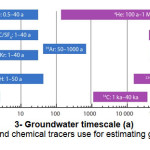 |
Figure1: Isotope and chemical tracers use for estimating groundwater age Click here to View figure |
- AGGARWAL, P., et al., Isotope Hydrology, IAHS Benchmark Papers in Hydrology No. 8, International
- Association of Hydrological Sciences, Wallingford, UK (2012). INTERNAT IONAL ATO MIC ENERGY AGENCY, Atlas of Isotope Hydrology: Africa, IAEA, Vienna (2007).

Article Metrics
 Views:
 PDF Downloads:
Citations

Publishing History
Review Details
Cite this article Cite

Cite

Help
author resource
ugc-care journal

member of

journal archived in

partenered with

visit us on


